Parliament votes on the 22nd amendment to the constitution today, which will conclude the debate which began yesterday. Widely criticised for months, hotly contested in the apex court, and drawing a final protest from the Opposition yesterday near the parliament roundabout, the much-anticipated judgment on whether or not the change requires a referendum reached Parliament on Monday.
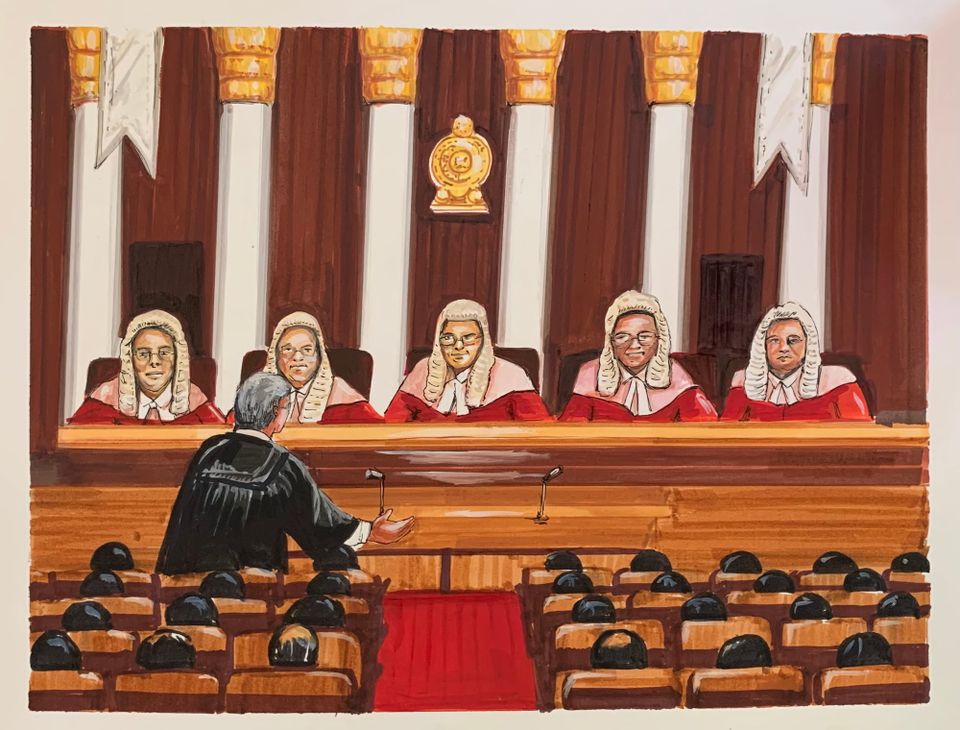
Ninety-six pages long, the judgement determined that passing the 22nd amendment — which raises judges’ retirement age by two years and adds five judges to the Court of Appeal — didn’t require a referendum. Two-thirds of Parliament voting in favour was enough, the Supreme Court ruled.
The retirement age has generated much controversy amid criticism from lawyers and the Opposition that the amendment is really about keeping Padman Surasena, the current Chief Justice who was due to retire this year, on the bench for longer.
Some lawyers opposing the amendment argued that increasing the judges’ tenures by two years would amount to an inducement, undermining judicial independence. They argued that if the amendment was prospective — applying to future judges and not those already on the bench — a referendum wouldn’t be necessary. However, as the amendment applies to sitting judges, the constitution demands a referendum, they said.
The judgement concluded there was “no factual or legal basis” for the claim that the judges had a personal interest in the case. The amendment would only constitute interference if the retirement of sitting judges were to be reduced, the Supreme Court reasoned.
One of the concerns with the 22nd amendment is that a future government could use the precedent to reduce judges’ retirement ages without a referendum. The judges held that wasn’t possible. The judgement was explicit — any reduction of judges’ tenures requires a referendum.
However, since the 22nd amendment increases the age at which judges step down, the court found the amendment doesn’t require a referendum. Drawing a parallel to salaries, they reasoned judges’ salaries rise from time to time with inflation, and that it would only be a problem if they were cut.
They also pointed out that there was a lack of precedent anywhere in the world where increasing judges’ tenures was found to undermine the independence of the judiciary.
Referencing the argument that the government was attempting “court capture”, the judgement pointed out that many sitting judges were appointed by past governments. “If the Government intends to "court pack", and appoint judges who may be ideologically aligned with the government, it can do so only if it permits the retirement of the incumbent judges,” said the judgement.
Rohan Edirisinha, an academic critical of the amendment, isn’t surprised by the court’s decision. He told The Examiner that the issue with the amendment was less legal, and instead more “principled/moral”. The problem, he said, is that the public may think courts could be co-opted or weaponised. The real test will be whether in the future the Supreme Court continues to uphold constitutionalism, and acts as a check on executive excesses.
Government’s rare opportunity
While the retirement age has been the focus of the controversy, the amendment also allows the government to appoint five extra judges to the 19-member Court of Appeal. There are four vacancies currently, with only 15 judges sitting, although yesterday the President nominated two for the Constitutional Council’s approval.
Once the amendment is passed, the government will be able to appoint judges to the existing vacancies as well as the new ones, nine in total.