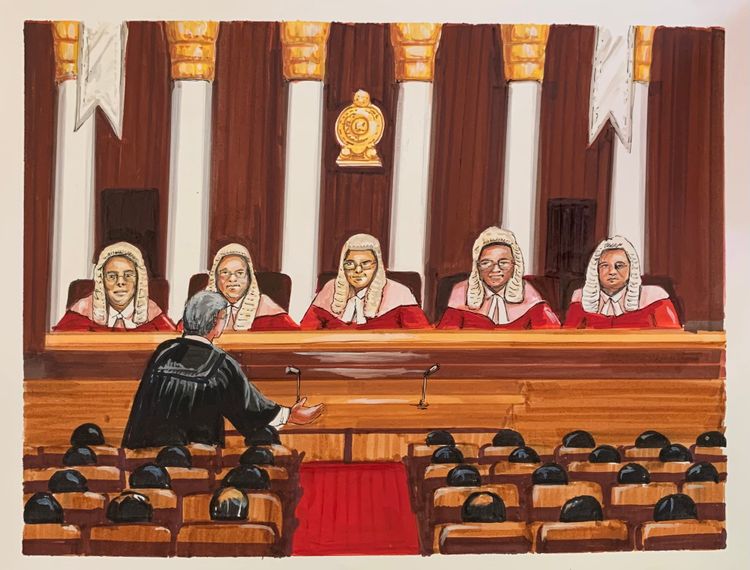
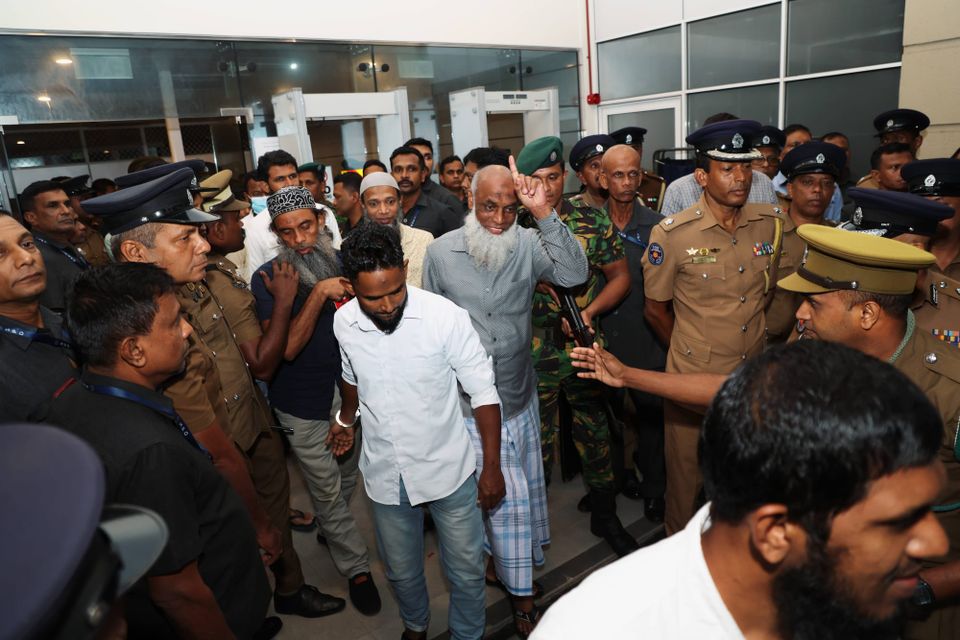
It was 5.30pm when Navaratne Marasinghe, the Easter Bombing trial’s presiding judge, read out the court’s judgement. In the packed courtroom, there were tears and embraces as he declared that nine of the 24 accused in the Easter Bombings were acquitted. Fifteen were found guilty. The attorney-general’s lawyers, who led the prosecution, then pressed for maximum sentences, which the three-judge bench imposed at 11.30pm that night.
The dramatic trial was heard from 2021, turning into a trial-at-bar sitting about twice a week. Since February this year, the trial has been heard every day. On Tuesday when the court’s verdict was read out, the audience was packed with journalists, top CID sleuths, and Catholic priests. Outside the courtroom, families of the bombings’ victims waited to hear word of the judgement, under a tent set-up for them by the police.
Forensic reports, testimony from at least 200 victims and over 2,000 witnesses, confessions given to the police, and videos of sermons were presented as evidence in the case.
Marasinghe repeatedly referred to two witnesses as he read out parts of the judgement. One of the witnesses had attended training sessions in Nuwara Eliya, organised by Mohamed Zahran, who led the National Thowheed Jamath that coordinated the bombings.
At these sessions, Zahran had divided the class into two: those who would be trained in suicide bombing and those who would launch other types of attacks. Another witness had been at many lectures given by some of those who were convicted.
Another piece of evidence, projected onto a big screen during the trial, was the last sermon given by Zahran, a day before the attack. In the video, he carried an assault rifle, while his followers brandished knives, and all were dressed in thobes with an ISIS flag in the background.
The guilty
Marasinghe began the proceedings at 12.30pm, first by apologising to those who had been waiting since 9am. The deliberations were a lengthy affair, he said, adding that he would only read certain critical bits of the judgement due to time constraints.
The guilt of the accused was established in several ways. With some, the court concluded that they conspired with Zahran to bomb churches on Easter Sunday in 2019, finding them guilty under the Prevention of Terrorism Act.
The evidence reveals that the accused, including Mohamed Naufer, alias Naufer Moulavi, Gafur Mama, Mohamed Rizkan, Mohamed Sanasdeen, and Ibrahim Sadiq, operated as a group together with Zahran and other suicide bombers who carried out the suicide attacks on Easter Sunday, said Marasinghe.
But with others, the evidence was different. For some, securing safe houses to hide explosives played a key role in their conviction. Two brothers, Sadiq and Ibrahim Shahid, were involved in the cover-up of a test bomb on a motorcycle. For Sadiq, getting weapons training in Syria five years before the attack was also consequential.
Importantly, the court observed that a conspiracy doesn’t require all those involved to be physically present together or have communicated with one another. An agreement to commit an offence could be formed either expressly or impliedly.
Once the guilty verdict was pronounced, prosecutors sought the severest possible sentence, recalling, as precedent, V. Prabhakaran’s trial in absentia for the Central Bank bombing. He was handed a 200-year sentence. Incidentally, Marasinghe was the lead prosecutor in that case.
“None of them have expressed any regrets. They are still holding on to their ideology,” said Harippriya Jayasundara, the lead prosecutor.