

Saabith Khan finished his A-levels in January this year. Two months later he got his results –9th in Puttalam. Three months later he got even better news. He’d cleared the z-score threshold for his first choice: Jayawardenepura.
It’s now been 200 days since Khan sat his last exam, and he still has no idea when lectures will begin. It could be weeks, or even months. “The waiting time is too long,” he complained. “Mostly it adds to a student’s age.”
The long wait
For the previous cohort, the time between the end of A-level exams and the first lecture took almost a year and a half. Some earlier cohorts have even taken two years to start university.
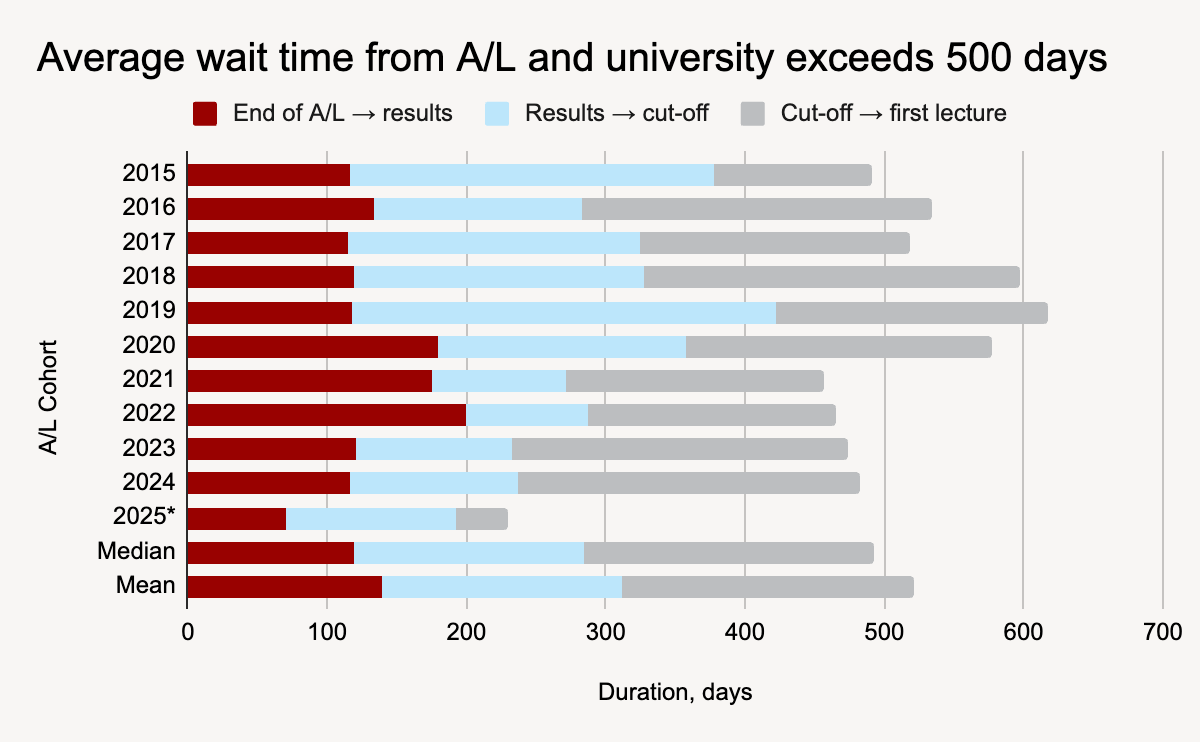
Using the first lecture date at Colombo University’s computing school as a benchmark, The Examiner calculated that in the past 10 cohorts students waited on average 521 days between finishing A-levels and starting university. Delays occur at every step of a three part process: 139 days for the Exams Department to release results, 173 days for the University Grants Commission to publish z-score cut-offs, and 209 days after that for lectures to begin. That adds up to roughly 17 months.
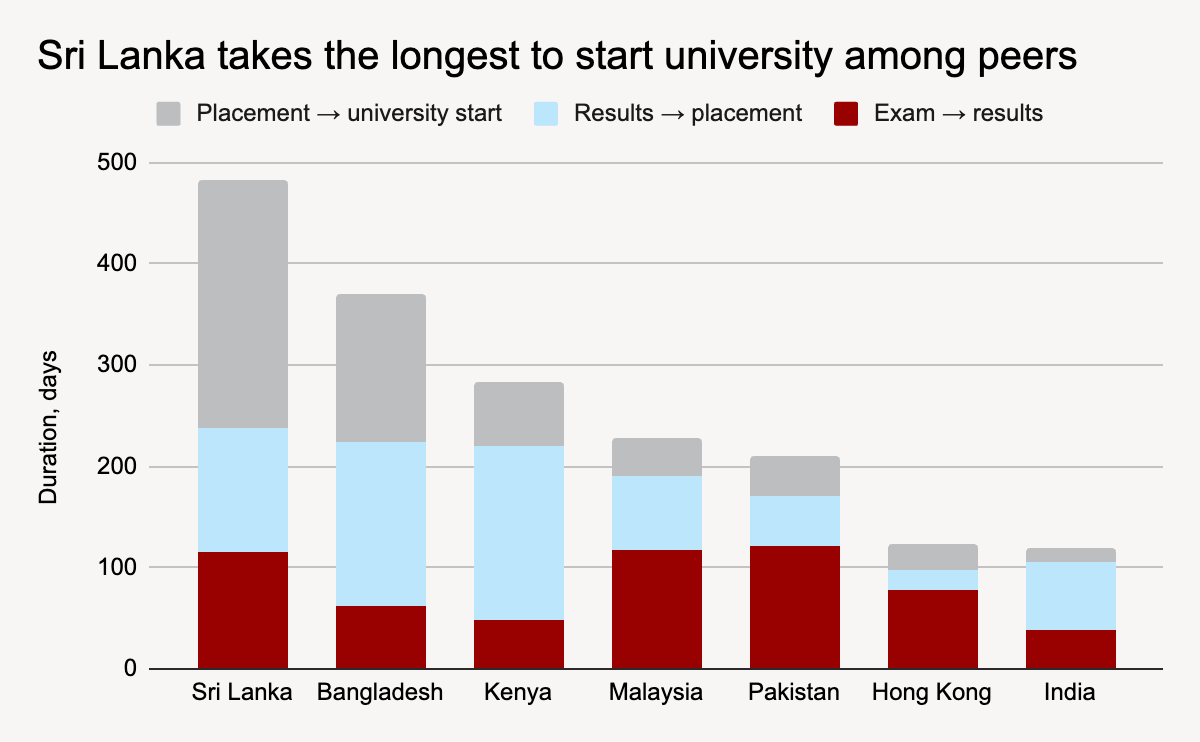
This isn’t the national average. Colombo computing was the chosen benchmark because their academic calendar for each year is available on their website. But students from other universities shared that they had similar wait times too.
Other countries wait similarly long periods for results and for placement. It’s the final leg, the gap between when placement ends and lectures start, where Sri Lanka lags the most.
It wasn’t always like this. From 1972 to 1977, students entered university approximately six months after sitting for the A-levels. The break came in 1978, when A-levels moved from April to August. Students then missed the approaching October university intake and entered the following September or October, a whole year later. Political violence lengthened that baseline. During the 1987–89 JVP insurrection, every university except Jaffna and Eastern closed; southern universities remained shut for much of two years.
The delay was reversible. A-levels returned to April in 2002, and two parallel intakes cleared the backlog. Same-year admission continued through 2007 until the examination returned, once again, to August. The present wait combines this late examination calendar with backlogs created by closures due to exogenous shocks like the pandemic. Faculties also never returned to a common academic calendar, instead starting whenever they were ready.
Every step of this process, from the last A-level exam to the first university lecture, has room for tightening. The timeline can be broken down into three handoffs. First, the Exams Department marking tests and releasing results; second, the University Grants Commission processing results, calculating z-score cutoffs, and sorting applicants into faculties; third, the universities enrolling students and starting lectures.
First handoff: exams department
Paper-marking kicks off immediately after both papers of a subject are complete, says Ashoka Garamadhasa, who’s been marking papers since 1999. Marking schemes are tested against sample answers; examiners are calibrated; scripts are back-marked and checked for omitted answers, incorrect totals, and transfer errors.
In the past, disputes over allowances have delayed paper-marking by weeks. Yet Garamadhasa estimates that ordinarily a marking round only takes about 10 working days. Entering and reconciling marks at the Exams Department, on the other hand, takes at least two months. Three operators separately enter every result into a computer.
This stage has operated with substantial vacancies, revealed a 2023 audit. The computer branch had less than half of its approved IT assistants and only a fifth of its assistant exam data officers. Those officers’ duties included entering exam data, making revisions, and recording marks.
The department doesn’t currently use on-screen marking, where examiners mark scanned scripts on a computer instead of using a red pen on paper before manually entering results. India’s Central Board of Secondary Education introduced on-screen marking this year. Its scale of close to 2 million candidates shows that digitised evaluation can be deployed in large public exams.
Past forays into digitisation haven’t all been successful. Optical mark recognition — where MCQs are corrected by a machine — was used in the 2005 A-level exams, but problems with it led to manual re-scrutiny of about 150,000 papers and the suspension of university admissions.
The technology was being reconsidered. A 2021 reform report described a digitisation drive including a pilot of tablet-based mark uploads, and a planned return to optical mark recognition. But so far these reforms haven’t been implemented.
Second handoff: UGC
Of the 281,810 students who completed their A-level exams last year, 176,527 became eligible for University Grants Commission, or UGC, admission. Of those, 92,043 hopefuls applied for the prized 42,937 spots.