The Examiner has more opinions than it has staff. We maintain unanimity in our facts, not the inferences we draw from them. This examination is no exception.
The first MP to draw a pension from Parliament was C.W.W. Kannangara. After retiring, he wrote to the speaker asking for a stipend as he had no savings after a lifetime in public service with little pay. Sirima Bandaranaike, the prime minister at the time, moved a parliamentary resolution which granted Kannangara 10,000 rupees in gratuity. Parliament later awarded him a pension of 500 rupees a year.
“He [Kannangara] is one of those statesmen, may I say, who has devoted a good portion of his life to the welfare and well-being of the people of this country,” said S.M. Rasamanickam MP, speaking in support of the motion.
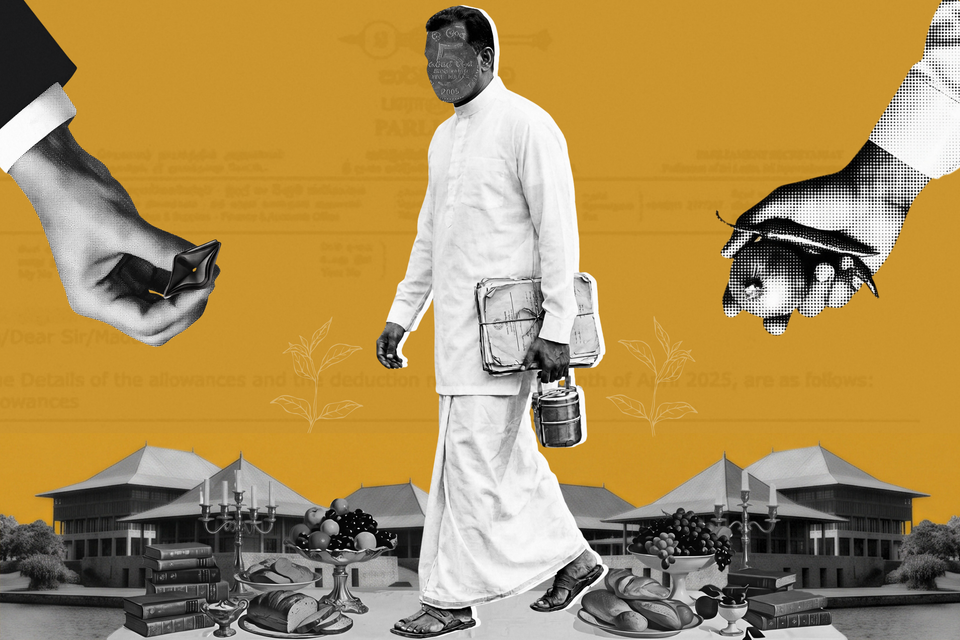
The pensions that came into effect weren’t necessarily generous, even for those who spent decades in Parliament, forgoing other careers. Sixty years and an Aragalaya later, the new NPP government retroactively terminated even these pensions for all retired MPs and their widows.
Ex-MPs feeling the brunt
This sudden withdrawal is being felt. Some former legislators are finding it difficult to buy medicines, while others can’t repay their bank loans.
“I’m begging without calling it begging,” says D.M. Bandaranayake, a former UNPer who spent 13 years in Parliament. Before he got elected, he would take up small construction projects — an income stream he gave up after entering Parliament. His Diyawanna career came to an end in 2004, with only a 75,000 rupee-pension.
When pensions were cut in February, 71-year-old Bandaranayake got no warning from Parliament. Since then, he has struggled to afford his monthly medicines — 12,500 rupees just for him alone, not counting his wife’s expenses.
He said the government justified the sudden policy change by saying all parliamentarians were thieves. “There were some who stole,” he said. “But we were in it for the public service. We served our people, and we were told we would get a pension.”
“I come from a normal family,” explained Bandaranayake. Had he known he wouldn’t draw a pension early on, his family would’ve adjusted before his retirement. “Now I am old, and have no option.”
Stories like Bandaranayake’s are common these days, says Karu Jayasuriya, ex-speaker and former UNP legislator. He’s been fielding requests for financial assistance constantly from ex-MPs this year, especially to cover medical costs like spectacles.
When the government first announced its intention to scrap MPs’ pensions, Jayasuriya, who leads an association for ex-MPs, met President Anura Kumara Dissanayake who told him that the JVP-NPP got a mandate to do so. Tilvin Silva, the JVP general secretary, and Bimal Rathnayake, house leader, had put forward the same reasoning to him as well.
“I don’t debate that,” says Jayasuriya. But the government must publicise the report that a presidential commission compiled on MPs’ salaries and pensions, adds Jayasuriya. He questions whether the committee really recommended cutting pensions for all MPs, or only future ones.
The debate about pensions for parliamentarians spills into a wider debate about how they’re paid in the first place.
Party first
The NPP, the ruling party led by the JVP, does things a little differently to other mainstream parties. During elections, it runs centralised campaigns. The party manages finances centrally and distributes money to candidates, who aren’t allowed to raise their own funds. This approach has some virtues; more women got the chance to enter Parliament. But the centralisation also means that the MPs must pay back, sharing their parliamentary salaries with the party.
Left parties often have a practice of asking members to contribute a share of their income to the party. For example, India’s Communist Party requires members to donate 4% of their income to the party, while the Communist Party of Sri Lanka charged a monthly flat fee from members. In the JVP members used to contribute their entire parliamentary salary back to the party, says Pemasiri Manage, an ex-MP who left the JVP in 2013.
Manage claims the JVP adopted this policy in 1997, after the local government elections when the party secured a hundred seats. He represented the JVP at the local government and provincial council levels, as well as in Parliament, contributing about 8 million rupees to the party in total, he says.
“We didn’t like this policy, but we had to be okay with it because we were part of the collective,” says Manage. “Back then, they didn’t even give a portion of the salary back to us.” He accuses the JVP-led government of being “cruel” by now scrapping pensions for all MPs.
Another former MP and ex-JVPer is struggling to treat his growing blindness due to glaucoma after the pension cut, he said. “It’s a very sad situation.”
Even so, Sellaththamby Thilaganathan, a first-time MP from the NPP, says they’re “happy” with the party-first system as the NPP paid their campaign expenses too. “We are like one family.”
After elections all NPP MPs were required by their party to open a BOC account to receive their parliamentary salary, three government MPs told The Examiner.