
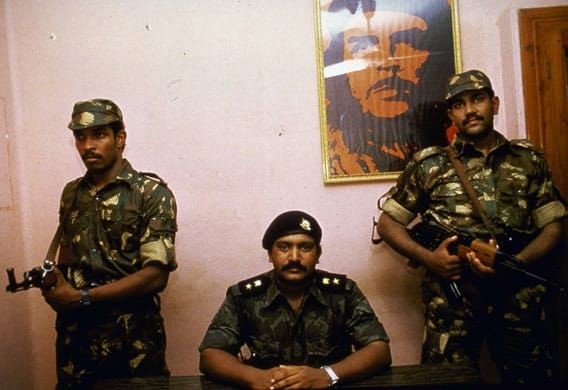
A review of Peter Stafford Roberts’ “The Sri Lankan Insurgency: Rebalancing the Orthodox Position” and Stephen Battle’s “Lessons In Legitimacy: The LTTE End-Game Of 2007–2009”
It is a truth universally acknowledged that in May 2009 the Government of Sri Lanka won the war.
This extraordinary turn of events, we are told, resulted from the political carte blanche granted to the Gotabaya, Fonseka, and Karanagoda troika. License from on high, the story goes, unshackled their hitherto caged military nous, and their single-minded focus on military victory.
Occasionally the Kumaratunga and Wickremesinghe governments’ victories survive the simplistic narrative’s hegemony. Here and there we are reminded of Karuna’s defection, the LTTE's overseas proscription, acquisition of blue-water capabilities, and development of LRRPs. Cumulatively these events caused the LTTE to split, cut-off their supply lines, and succeeded in eliminating a number of senior leaders.
Some observers even argue that the revival of the Sri Lankan economy under the Wickremesinghe regime laid the foundations for the government’s technological and manpower superiority in Eelam War IV.
Sophisticated or stupid, the narratives at our disposal place agency in the hands of the political and military leadership in Colombo. That is the true hegemony of our thinking about the war’s conclusion.
Peter Stafford Roberts’ doctoral thesis, “The Sri Lankan Insurgency: Rebalancing the Orthodox Position”, is the Kamba Ramayana to these Valmiki Ramayanas. Following R. Hariharan’s 2009 Frontline cover story, he argues that Prabakharan’s choices, rather than decisions made in Colombo, led to the Tigers’ extinction after thirty years. In other words, the war ended in an LTTE loss rather than a government victory.
Roberts argues that there was nothing fundamentally new in the government’s strategy during Eelam War IV. J.R.’s military solution, Chandrika’s ‘war-for-peace’, and Ranil’s peace talks all failed as strategies for defeating the LTTE.
In his view, the balance of power between the government and the LTTE also remained broadly stable over time. This, he thinks, is good reason to doubt that Colombo was responsible for the LTTE’s defeat. Instead, echoing Hariharan, he thinks that it was the LTTE leadership’s failure, particularly Prabhakaran’s failure, to comprehend and respond to the emerging domestic and international realities that led to the Tiger’s demise.
Interviewing ex-LTTE cadres who escaped the Vanni, Roberts pieces together a narrative of the war from the LTTE’s perspective. He corroborates and supplements these sources by his unprecedented access to both the Sri Lankan army’s archive and the RAW archive. Collectively they tell us a very different story.
Cadres who worked closely with the top LTTE leadership, suggest that Balasingham’s death and Karuna’s defection were the primary reasons for Prabhakaran’s loss of strategic agility.
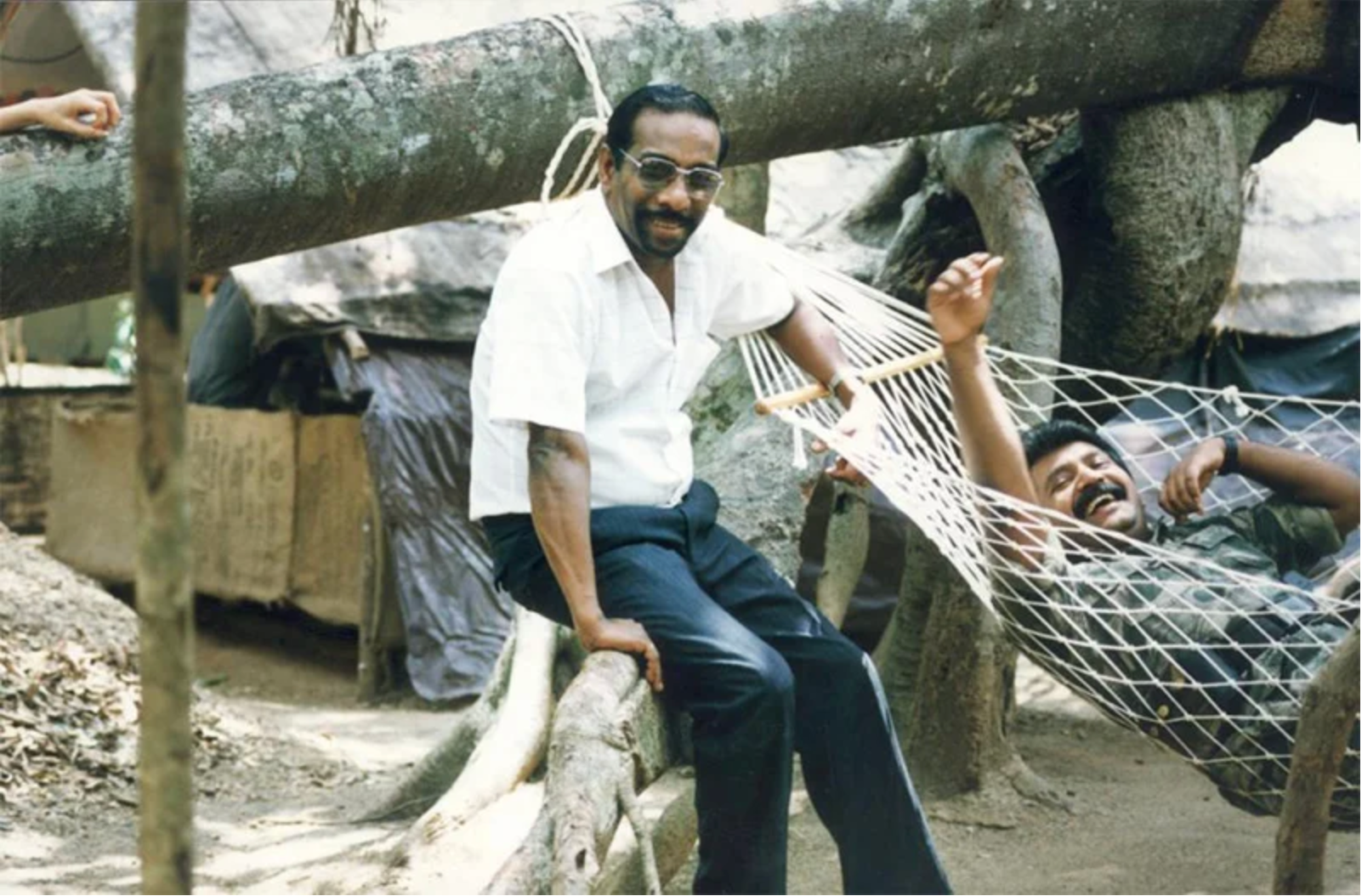
Balasingham’s fatal death
Balasingham’s absence, the thesis opines, left Prabhakaran without a foil to debate and think critically.
Balasingham, Roberts argues, was vital in shaping Prabhakaran’s thought because he was (i) uniquely able to critique his assumptions and logic, (ii) sufficiently trusted that Prabhakaran could admit mistakes without losing face, and (iii) he was the sole senior LTTE leader who had a reasonably sophisticated understanding of politics and diplomacy.
He also attributes Balasingham’s apparently exceptional influence to his close personal relationship with the Tiger supremo; particularly Balasingham’s singular ability to put Prabhakaran at ease, even inducing him to violate the LTTE code by smoking and playing poker.
After Balasingham’s death Prabhakaran increasingly alienated the international community.
For example, in 2005 the LTTE deviated from its post-9/11 policy of focusing on military targets. Furthermore, Prabhakaran was surrounded by individuals who were either blinded by their devotion or were ‘working towards the Führer’. Therefore, Roberts concludes, Prabhakaran’s strategic powers ossified.
He was no longer an adaptive, agile leader. As the government’s strategy and the international environment transformed, Prabhakaran and the LTTE failed to develop an effective response, sticking to their doctrine of conventional, territory-holding war, complemented by asymmetric attacks on targets outside the battlefield. This remained the case even after it became obvious that this strategy was leading to catastrophe.
Karuna’s crucial defection
Prabhakaran’s rigidity, Roberts claims, was only exacerbated by Karuna’s defection. Prabhakaran became increasingly paranoid and focused on matters internal to the LTTE. Investigations and trials became de rigueur and planning for military operations faded into the background.
In a manner reminiscent of Mahinda Rajapaksa in his second term, Roberts concludes that “[Prabhakaran’s] immediate circle, including Prabhakaran’s family, were contributing to his nadir and eventual failure by their blind faith in his judgment and ability. If anything, Prabhakaran had surrounded himself with a group that was reinforcing the failing strategy”.
Nonetheless, the very virtues that endow Roberts’ thesis with its exciting iconoclasm — anonymous interviews, employment of GCHQ technology, and access to closed archives — are also the source of its premier vice.
The results of Roberts’ thesis cannot be replicated and therefore their veracity cannot be tested. Naturally there is little Roberts could have done to mitigate these drawbacks. But it does mean that we cannot take his facts or his conclusions at face-value. All the more so in virtue of Roberts’ reliance on the accounts of a handful of interviewees.
Other than his somewhat unpersuasive argument that the strategic balance between the Sri Lankan government and the LTTE stayed roughly constant over the course of the war (despite significant investment in the government’s manpower and armaments), he also fails to adequately explain why senior commanders, like Pottu Amman, KP, and Balaraj, could not play the role Balasingham and Karuna did. Nor is he entirely persuasive in his account of the change in Prabhakaran’s psychology and subsequent failure to adapt post-2005.
Finally, he does not analyse alternative strategies Prabhakaran could have adopted, such as abandoning conventional warfare to fight a Maoist guerilla war.
But, all in all, much of the material is new and Roberts obviously knows more than he can say.
In terms of corroborating Roberts’ evidence, the only other source known to this author that considers the war as an LTTE loss rather than a government win is a master’s thesis by Stephen Battle, a US army major, titled “Lessons In Legitimacy: The LTTE End-Game Of 2007–2009”.
Battle argues that the LTTE’s dependence on the Tamil diaspora transformed its relationship with the Tamil population in the North and East. Persuasion gave way to coercion.
The most emblematic example being ever-more-demanding conscription to refill depleted ranks. Ultimately choosing coercion, Battle argues, led to a loss of legitimacy among the Tamil population in the North and East.
The crux of his argument is an inverse relationship between foreign support and domestic accountability. In Battle’s words, as the LTTE became more “famous internationally, among the Tamil diaspora, they became more infamous domestically, amongst a greater number of local Sri Lankan Tamils”.
In 1983 the LTTE’s dependence on the diaspora was virtually nil. But by the turn of the millennium nearly 80% of the LTTE’s operating budget was funded from overseas sources. Concomitantly, the LTTE, which turned away recruits in the 1980s, started conscription in the 1990s. By the early 2000s every family needed to hand over a child.
This may explain a key puzzle Roberts poses: why did the LTTE not change strategy to fight another day? Why did they not melt, Maoist fashion, into the population and move among the people as a fish swims in the sea?
Roberts’ or Battle’s theses are not cast-iron evidence for one view or another. Instead, they are better thought of as an invitation to reconsider our own understanding of the events that led to the end of Sri Lanka’s civil war. It also reminds us of how little we really know about our recent past.
An abridged version of “Inside an elusive defeat”, originally published on Colombo Telegraph in 2018.
Comments ()