

In March 2020 a large backhoe tyre was rolled down a staircase at the Jayewardenepura University. Pasindu Hirushan Silva, then a first-year commerce student celebrating what was supposed to be the end of the rag, was standing below. The tyre hit him. His skull fractured; brain trauma, retrograde amnesia, and partial paralysis followed. He spent over three months in intensive care and was operated on multiple times.
For four months prior to the night of the incident, male freshers in his batch had to wear rubber slippers, long trousers, and shirts, and cut their hair short and shave, Silva told The Examiner. Women had to plait their hair and dress in prescribed ways. Students who didn’t comply were ostracised — they weren’t allowed to attend events and were stopped from using most canteens. In the hostel there were “night meetings” for male students.
“I remember one person being slapped very hard,” he said. “They didn’t need a reason.”
Too injured to sign a fundamental rights petition himself, Silva’s sister had to sign it for him. Silva’s case turned into a national inquiry on whether universities had systems capable of preventing the next serious ragging incident. The Supreme Court added university vice chancellors, the inspector general of police, and the minister of higher education as respondents, and asked universities to account for their own anti-ragging systems.
Law now focusing on prevention
The Supreme Court’s determination did not equivocate. It said that despite anti-ragging measures, enforcement remained “elusive or, at its best, abrupt and inconsistent”. Complaints were often ignored or inadequately addressed.
The court also quoted Ruhuna University’s vice chancellor as saying it wasn’t possible for ragging to exist for long without the university authorities’ knowledge, “they were part of the whole process,” he said.
In July 2025, the Supreme Court issued anti-ragging orders to the University Grants Commission-governed universities. Each university had to establish a victim-support committee, run emergency hotlines, respond to complaints within three days, and follow up with police.
A few months later the commission circulated the judgment to vice chancellors via a circular. Universities were told to give effect to the court’s guidelines. Failure to comply, the circular warned, could amount to contempt of court.
Prabha Manuratne, a professor and director of the commission’s Centre for Gender Equity and Equality, said this was the difference between the court order and the 1998 anti-ragging act. “The anti-ragging act focuses on the crime,” she said. The court order asks what universities did before and after the crime. “That judgment is about institutional responsibility.”
No prosecutions
The anti-ragging act makes ragging punishable by up to two years' rigorous imprisonment. If ragging causes sexual harassment or grievous hurt, the sentence can rise to 10 years.
The act isn’t limited to the person who lands the blow or commits the sexual assault. It applies to anyone who “commits, or participates in” ragging. Ordinary criminal law can deal with assault or sexual assault. The anti-ragging act is meant to reach the seniors around the violence too.
While Manuratne believes the legal mechanism surrounding ragging is relatively robust, she is unconvinced that Sri Lanka has utilised it effectively. “We’ve had an anti-ragging law since 1998. Ask around and see how many prosecutions have actually happened under this act. Very, very rarely,” she said.
She’s studied ragging as structural violence. “Ragging is not one thing,” she said. “There’s a legal dimension to it. There’s a very, very sociological dimension to it.” If one sees only one aspect, she said, “then you miss the big picture”. The point of analysis is not only the individual perpetrator but also the “silent, but very insidious institutional or social arrangements that sustain violence.”
The problem is compliance, agrees Yasu-e Karunaratne, lawyer and co-founder of Rage, an anti-ragging collective. She argues that Sri Lanka already has some good laws and directives. Although the law exists, it’s only as good as its compliance, she said. “You have to execute it.”
Echoing Manuratne, she points to deeper cultural causes. Society has not yet accepted ragging as wrong in the way it accepts murder or rape as wrong, she says. People still debate it.
Who’s responsible?
Three of Sri Lanka’s 16 residential state universities responded to The Examiner’s RTI requests on their anti-ragging measures. They described the same basic formal architecture, mirroring what was laid down in the Supreme Court judgement.
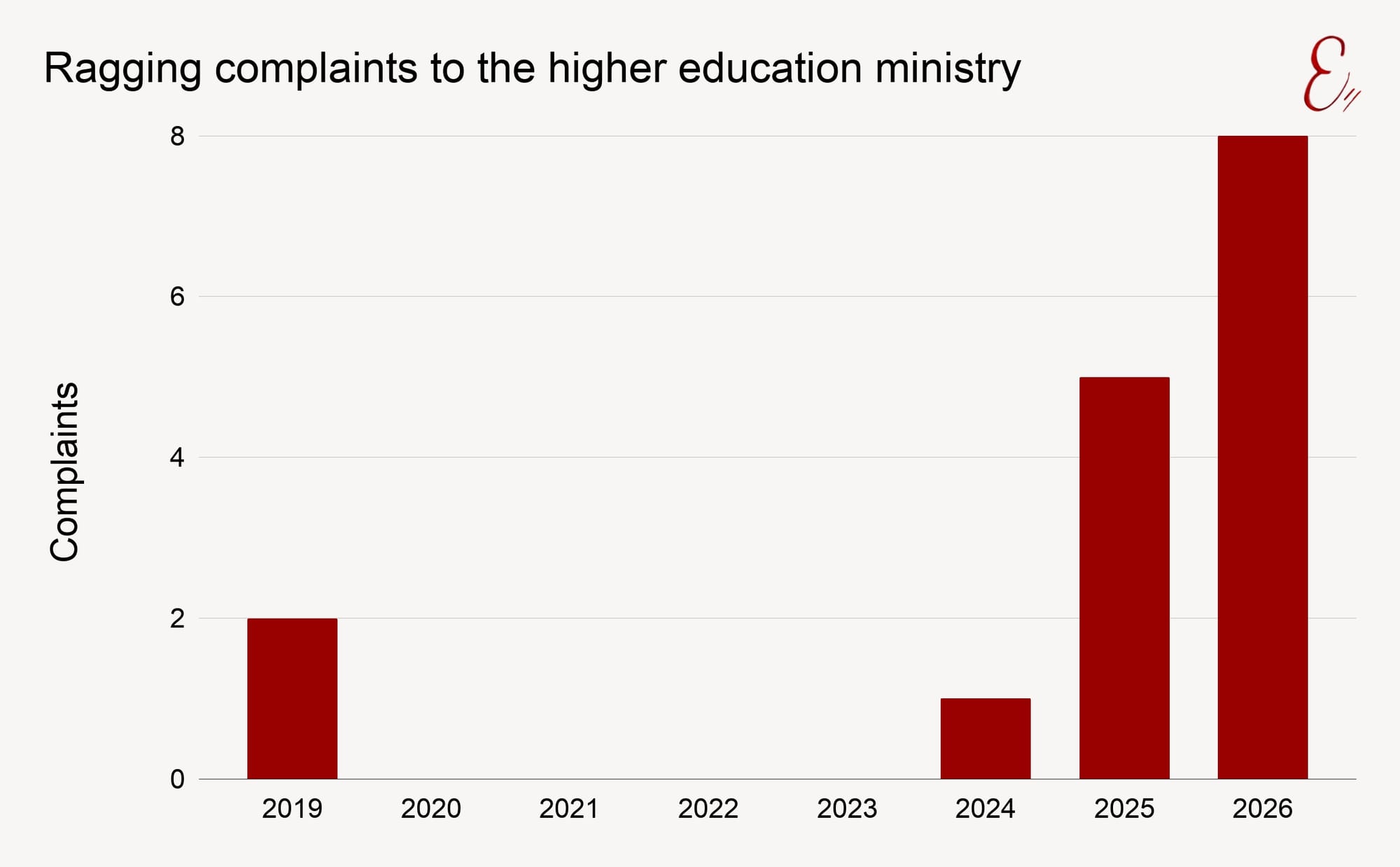
A victim support committee, 24-hour hotlines, counselling services, and hostel controls, alongside mentorship and orientation programmes.
But these formal structures clearly aren’t working. Neither Colombo nor Vavuniya universities recorded any ragging complaints since 2020.
At Colombo University A.V.P.D. de Silva, the acting deputy chief marshal, said the marshal’s office operates around the clock. It has 18 officers for about 20,000 undergraduates across a scattered university. At night, he said, two male officers are on duty.