The Examiner has more opinions than it has staff. We maintain unanimity in our facts, not the inferences we draw from them. This examination is no exception.
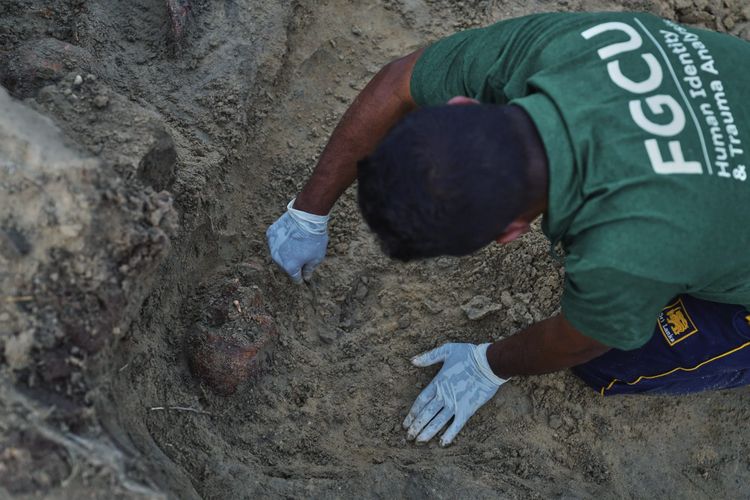
A woman in green hospital scrubs, in her late forties with salt-and-pepper hair tied in a bun, uses a toothbrush to scrape hardened mud off a skeleton stuck in the earth.
She’s inside a two-metre-deep trench. Several others are there with her too. They're dressed more casually but all of them still wear surgical gloves, and either a cap or a wide brimmed hat. They’re meticulously chipping dried mud away from bones — the bones of over 570 skeletons exhumed here at Chemmani since May 2025.
Chemmani is a village marking the entrance to Jaffna from the south. The village’s centre is a three-way junction — the site of a notable checkpoint during the war years. In 1995, after the army recaptured Jaffna from the LTTE, the Chemmani checkpoint became almost synonymous with kidnappings and disappearances. The Nesiah Committee, which investigated 280 cases of enforced disappearances in the Jaffna region in the late ’90s, found that the Army was responsible for the vast majority of them.
The committee’s report describes Chemmani as a vast stretch of shrubland where hundreds of disappeared persons are believed to have been buried following roundups and arrests by the armed forces.
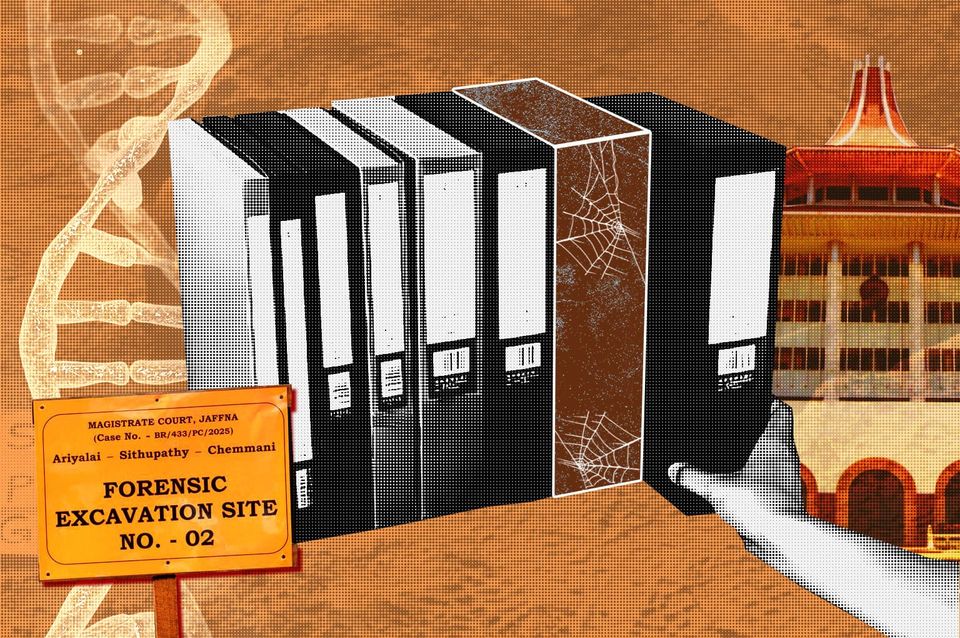
A clandestine burial site was first discovered in Chemmani in 1999. The courts ordered DNA testing on the remains found there. The test report was never made public. Families weren’t even told if the results matched. The court case was suspended, the arrested soldiers were released, and today, The Examiner learns that the Colombo Magistrate Court’s case records are missing.
Missing persons turn up murdered
The 1999 Chemmani mass grave was first revealed by Somaratne Rajapakse, an army lance corporal. He and four others were sentenced to death for the gang rape and murder of 18-year-old Krishanthi Kumaraswamy, who was detained at the Chemmani checkpoint. They were also found guilty of murdering three of Kumaraswamy’s family and friends who went looking for her. This conviction and that of Sunil Ratnayake were the only convictions of soldiers for wartime atrocities so far.
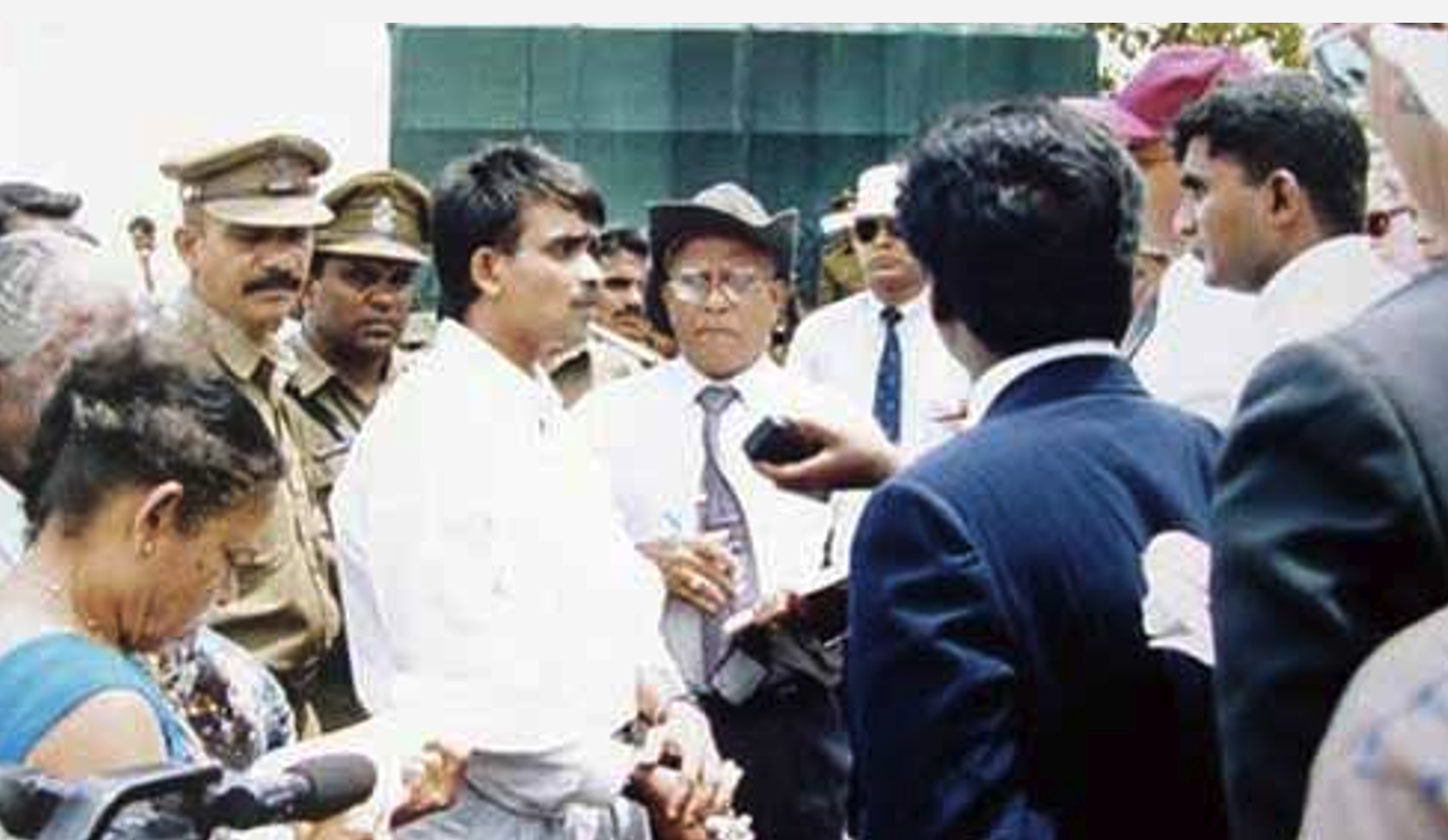
“It was not easy to determine the cause of death, let alone identify the bodies,” says Prashanthi Mahindaratne, the Attorney General’s Department lawyer who prosecuted Kumaraswamy’s case.
“When we were examining the bodies, we saw identical laundry tags. In Jaffna those days, dhobis used to tag clothes from one house with a unique marker. That’s how we were able to identify the bodies,” she said.
In his final address to court after his death sentence was read out, Rajapakse said that as many as 300 bodies were buried where Kumaraswamy’s body was found.
1999 mass grave and its missing file
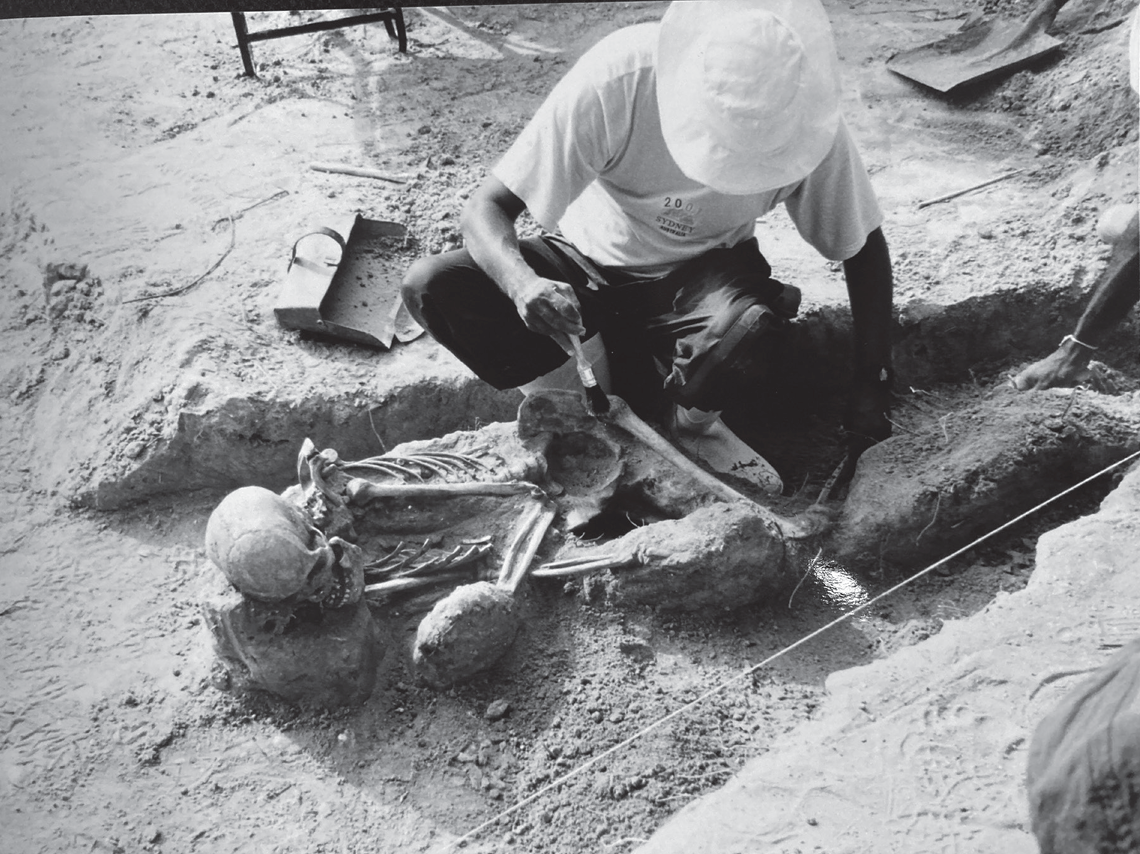
As the Kumaraswamy trial ended, a new investigation began — this one into the suspected mass grave in Chemmani. In August 1999, Rajapakse and the other convicts pointed out 27 locations altogether. Their testimony proved correct. By the end of September that same year, 15 bodies — all aged 14 to 40 — were found at eight of the locations.
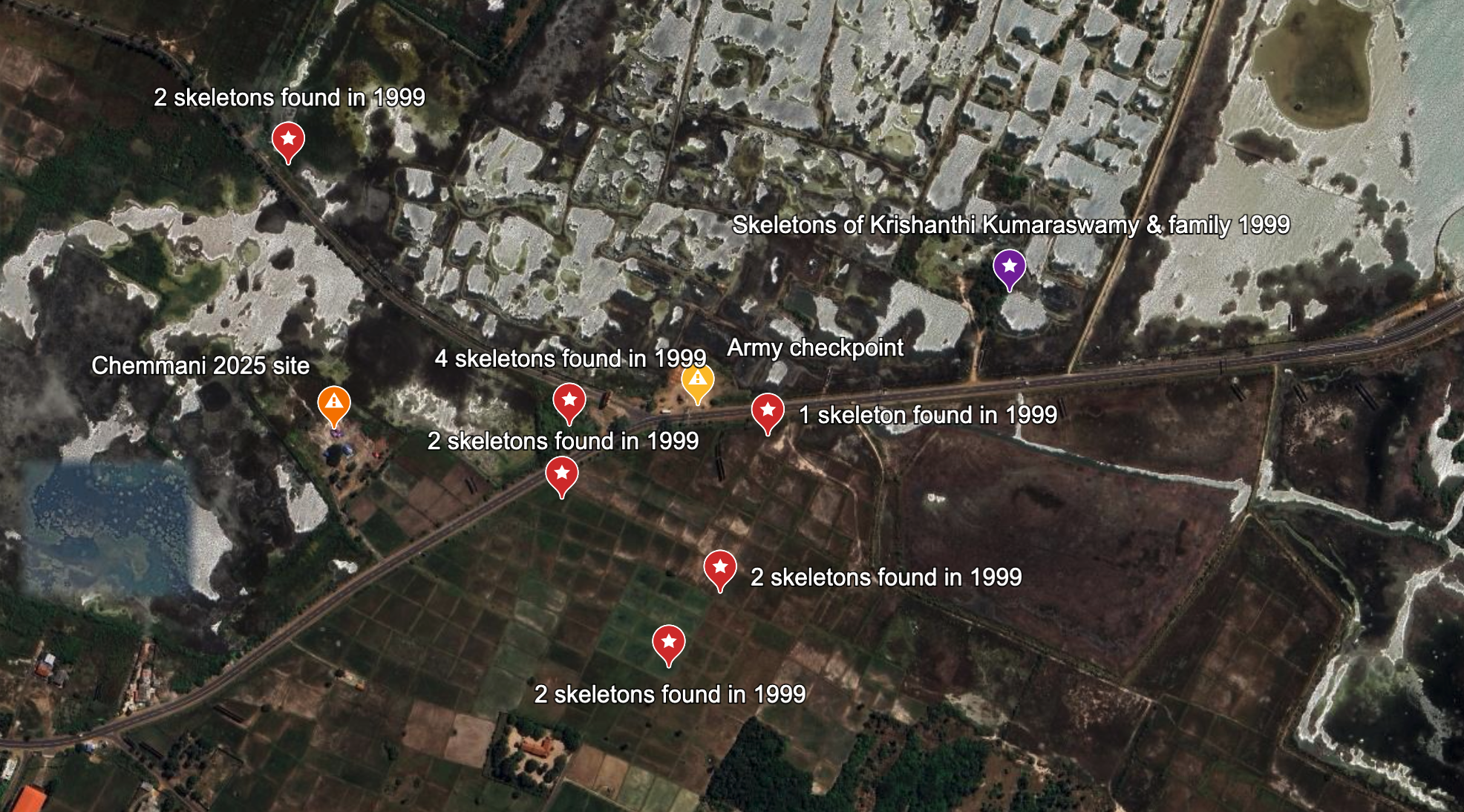
The forensic evidence found that the bodies all had perimortem wounds, meaning wounds inflicted around the time of death. Twelve of the deaths were ruled homicides, mostly from blows to the chest or head, and one from a knife cut to the neck. One was classified a possible homicide, and two were unascertainable. Only two skeletons were fully clothed. The rest were nude or in underwear. The two who died clothed were identified by relatives, a wife and a sister, based on what they were wearing.
“These positions [the postures of the bodies] conclusively exclude the possibility of legal and/or ritual burial/s,” wrote Niriellage Chandrasiri, a professor of forensic medicine, in his report “Revelations of Chemmani Graves”. The report was published posthumously in 2014, eight years after he passed.
Based on the forensics and witness statements, the police’s CID arrested four soldiers in March 2000. The soldiers argued they wouldn’t be safe if they appeared in the Jaffna courts, so the case was transferred to Colombo in mid-2000. Their lawyer, Mohan Peiris, then successfully applied for bail. Peiris would later go on to become the attorney-general in 2008.
Yasantha Kodagoda, a state counsel at the Attorney General’s Department, handled the case. The department never filed any indictments.
Six years later, in 2006, the police told the Colombo magistrate that they were unable to proceed in the absence of instructions from the attorney-general, despite having handed over their findings. In March 2010, the case was laid by, meaning it was temporarily paused. It has remained in this limbo since.
Years later, the key suspects in this case were promoted. Lalith Hewa, a captain, retired in 2024 as a brigadier. Shashika Perera went on to become the general commanding officer of the 52nd infantry and then retired as a major general. Sachindra Wijesiriwardana, a lieutenant, got a position at the Army headquarters. A. Yatagama, also a lieutenant at the time of arrest, retired as a captain in 2013.
Though the courts haven’t heard the case since 2010, the case isn’t closed. The 15 skeletal remains have gone missing, as neither the lawyers representing families of those who disappeared in the area nor the Office of Missing Persons, OMP, is aware of their whereabouts. Bone samples of all 15 were sent for DNA profiling to the University of Glasgow’s forensics department. The OMP believes that the DNA analysis never reached the Sri Lankan authorities.
But that’s not the case.