
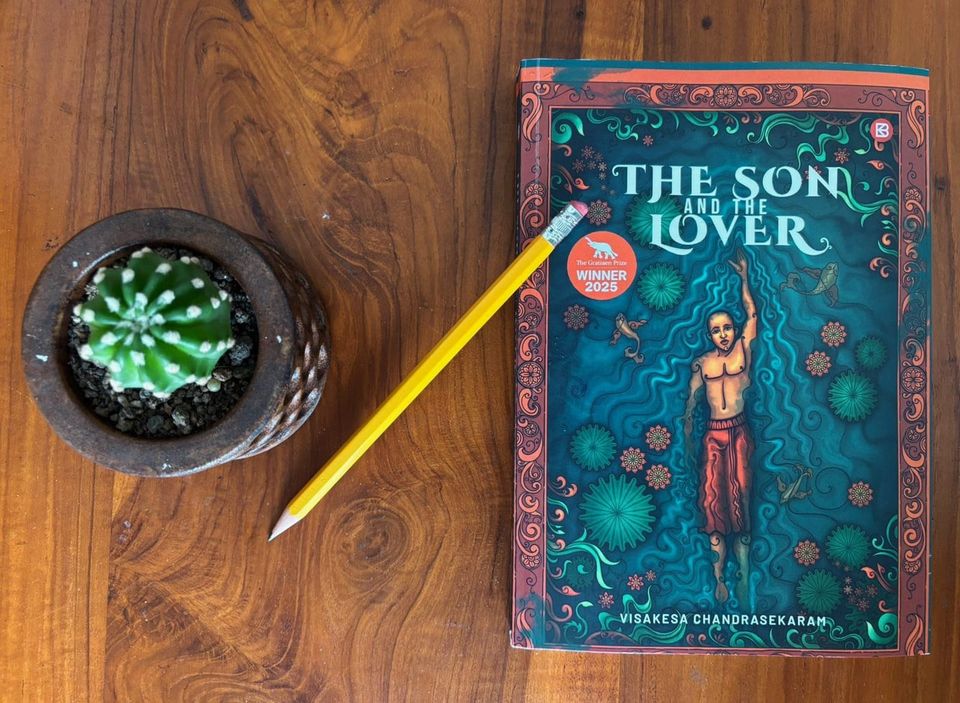
To write about a novel, one must first be addressed by it. But such an address begins before a cover is cracked open, before a single page is turned. This is especially true of a novel that has just won the Gratiaen Prize, the annual award for the best work of creative writing in English by a Sri Lankan author. For many of its first readers, Visakesa Chandrasekaram’s “The Son and the Lover” will already be framed by this appraisal of its worth, tempered perhaps by a vaguer assertion of its “Sri Lankan” identity. It is in relation to such an identity that the novel has already been cast as controversial, if not transgressive: a work that breaks away from the norms of Sri Lankan society, which, in the words of one of this year’s Gratiaen judges, “is perennially chained to heteronormative politics and Buddhist ideologies.” After all, at least at a surface level, the novel’s premise — a queer, transborder romance between a Sri Lankan Buddhist monk and a white Australian man — may strike some readers as provocative. And, holding this KBooks published novel in their hands, at least few are bound to sense in its cover and print a general “left liberal” or “progressive” Sinhala lit aesthetic that has come to the fore in recent times. Even before the novel begins, transgression is very much in the air.
From addressing to undressing
If “The Son and the Lover” reaches us dressed in a transgressive cover—both literally and figuratively—it soon begins to undress. The novel stages this stripping from the outset: the cover image of a partially undressed monk, suspended like an island unto himself in a turquoise stream, already signals what is to come. We soon learn that this is the 32-year-old Hasithaloka Thero, who becomes a powerful object of desire for Phil, a white Australian physiotherapist.
Phil’s desire sits within a long history of the homoerotic colonial gaze, where brown male bodies are rendered desirable through a series of contradictions. Hasithaloka is at once mystically wise and irrationally dogmatic, violently masculine and exotically feminine, a figure to be saved and a figure through whom salvation might be found. As their romance unfolds — and the young monk eventually disrobes, migrates to Australia with Phil, and later leaves him to return to the island — his name itself begins to unravel: Hasithaloka becomes Hasitha, then Hasi.
Crucially, as the monk sheds his name and robes and steps into a life where formerly illicit desires acquire social and legal recognition, the novel’s “transgressive” surface comes apart. What remains is the mundane, often excruciatingly normal, world of human intimacy. As accolades, titles, and names give way to the prose of inner life, the maya of transgression is dispelled.
This is perhaps the novel’s most striking achievement: its ability to take us beyond the binary of “normalcy” versus “transgression,” into a world where queer desire — homoerotic, interracial, transborder, intercultural, what have you — can be encountered as singularly human and perfectly ordinary. Acknowledging this feat helps us read the novel’s stylistic simplicity — and even prosaicness — somewhat generously. Stripped of the formal experimentations and provocations typical of prize-winning literary fiction, “The Son and the Lover” is very much an easy read.

This simplicity, however, appears as a deliberate choice. Indeed, Chandrasekaram may be quietly signaling this preference through Phil’s repeated inability to finish Shehan Karunatilaka’s 2008 Gratiaen-winning “Chinaman,” a novel whose form is relatively more complex. Perhaps Phil is too overcome by sensual bodily stirrings to render more cerebral language digestible. In the absence of formal experimentation, the simple form of the romance begins to work, grappling with questions that are by no means simple: love, attachment, sexuality, and spirituality. Rather than offering an intellectualised critique, the romance opens a powerful space of desire in the reader’s heart—a space in which gender, race, nationality, religion, and culture no longer function as symbolic props that predetermine and fix human relationships. Yet neither are these categories simply wished away. Instead, they are presented as complex realities that must be grappled with in order to find ethical ways of being with others.
Relinquishing and returning
Transgressive though it may not be, “The Son and the Lover” doesn't shy away from critiquing Sinhala Buddhist ideology, its entrenched ethnonationalism, historical revisionism, Islamophobia, and politicisation of the sangha.
Yet the novel is as invested in imagining forms of Buddhist and queer futurity — futures in which Buddhism and queerness need not be mutually exclusive — as it is in unsettling the notion of the West as an inevitable site of sexual liberation and personal freedom.
This framing emerges from within Hasi’s world itself. The ex-monk-turned-immigrant-turned-returnee isn’t simply instructed by the West to adopt a more questioning outlook that undoes his chauvinism and Islamophobia. Its impetus remains internal, shaped by the reality of his desires, relationships, and circumstances. After all, Hasi chooses to return to Sri Lanka and, however painfully, to his mother. At the same time, it doesn’t deny his encounter with the West either: such as in Phil’s grandmother, Grace, who helps nurture his transformation.
And although, by the time of his return he is no longer a monk but a more “enlightened” and “open-minded” young man, this island-based, Buddhist-inflected futurity remains far more precarious if not unimaginable for many. At the same time, however, it’s also possible to frame the kind of futurity the novel offers not as Buddhist or even as queer, but as decolonial and human.
Hasi’s reconfigured Buddhist quest — the quest of renunciation — begins not during his years as a monk but at the moment he ceases to be one. Indeed, a central act of renunciation involves relinquishing the comforts and authority of the Buddhist priesthood, sustained by both Sinhala Buddhist society and the Sri Lankan state, in order to confront his desire directly. The task is not to overcome, tame, or repress sexuality, but to acknowledge it, assume responsibility for it, and discover ways of living with it ethically.
Such an undertaking is by no means exclusive to Buddhist monks, nor is it particular to those whose desires are deemed transgressive. It is, rather, a fundamentally human challenge. If Hasi ultimately returns to certain Buddhist ideas, seeking within them not only answers but new questions, what emerges is neither an organised religion nor a coherent ideology that deserves the name “Buddhism.” Instead, it is a mode of inquiry that resists affiliation and identity: detached from national belonging, unsponsored by the state, and open to new forms of being in the world as an imperfect and continuously desiring yet always questioning human subject.
Beyond symbolic purity
The release of “The Son and the Lover” could not, in a certain sense, be timelier. Over the past month, several members of the Buddhist sangha have been at the center of controversy involving inappropriate and, in some cases, illegal sexual conduct. Some, including the former Chief Prelate and Custodian of the Atamasthana in Anuradhapura, Pallegama Hemarathana, face serious allegations. The problem, however, in much of the public discourse surrounding these cases is that sexual abuse and rape — at times involving minors — are subsumed under cultural concerns regarding monastic celibacy. In this framing, the central issue shifts away from abuse itself and toward questions of purity and abstinence versus lust and sexual transgression. What is at stake becomes not the violation of a child or non-consenting adult, but the perceived failure of monks to uphold the ideals of celibacy.
Within segments of the Sinhala Buddhist community, efforts are often made to preserve the sanctity of Buddhism and the ideal of monkhood by disavowing such figures as monks altogether. Those accused are reclassified as “individuals in robes” (cheevaradhaarin in Sinhala), as though the problem could be contained by separating institutional identity from individual practice. Yet this gesture of disavowal forecloses the possibility — and indeed the reality — of monks as ordinary human subjects, who are not only capable of sexual desire, but often act upon it, sometimes in ways that violate cultural boundaries, and at times, even ethical and legal boundaries. The gesture renders monastic sexuality unspeakable, shutting down space for meaningful public reckoning. The result is that even the most serious instances of sexual abuse risk being displaced, absorbed into debates about celibacy, and ultimately obscured.
The novel does not — beyond a single passing reference — engage directly with the issue of sexual abuse in temples. It does, however, open up space for more sustained and nuanced reflections on sexuality and desire within Buddhism and the sangha. Central to this is its refusal of a stable binary between “normalcy” and “transgression”. To designate certain acts as transgressive is, implicitly, to assume the existence of an opposing realm of purity; a logic unsettled by the novel’s insistence on the complexity of human desire. In doing so, it gestures toward forms of responsibility that exceed mere legal compliance, pointing instead to ethical modes of living with desire that cannot be neatly codified. Chandrasekaram’s “The Son and the Lover” moves the reader in this direction, where sexuality is neither to be tamed nor to be liberated, but to be continually negotiated. Nothing is a given, and everything is a question. Unknowable and fickle, the core of human desire itself — whether it expresses itself through a Sinhalese, a Muslim, an Australian, a man, or a woman — is queer.
Fiction, of course, takes time to make its mark. Slowly and suggestively, it shapes not only how we see and understand the world, but how we come to inhabit desire itself. One hopes, therefore, that in the years to come, the novel will inform conversations both in Sri Lanka and beyond on pressing questions concerning the human that cannot be swept under the rug: questions of sexuality, spirituality, racism, and religious fundamentalism. Doing so, it may offer us glimpses of foreclosed futures, of reckoning, and even perhaps of healing.

Comments ()