
It's just past six in the morning in Munisirigama, and Hemachandra Wijesinghe stands at the edge of his paddy field, looking over his 2025 Maha season crop. He’s ploughed the land for over four decades — his entire life shaped by paddy’s golden grains. But this season, something’s different.
Before him, there seem to lie two lands: one going through the familiar rhythms of green and yellow, and another, greener, fuller, more alive. The season, soil, and variety of seed are the same. The only difference is the fertiliser he applied.
Munisirigama sits in Polonnaruwa, at the heart of Sri Lanka’s ricebowl. The district accounts for nearly 13% of the island’s paddy production.
Munisirigama is home to thousands of paddy farmers like Wijesinghe. These farmers have been struggling for years now in an industry stuck in the past. Unstable policies along with sub-par inputs — like fertilisers — means that they’re forced to be risk-averse and traditional.
“The land doesn’t get bigger,” Wijesinghe says. “But the population is growing. So, we need to find new ways of improving our land and yields.”
A farmer’s gamble
For most of his farming life, Wijesinghe used government-subsidised fertilisers. They came under different brand names like Lakpohora, but the same three fertilisers were inside every bag: either urea, muriate of potash, or triple super phosphate. They provide the three main nutrients — nitrogen, potassium, and phosphorus — that a paddy plant needs to grow.
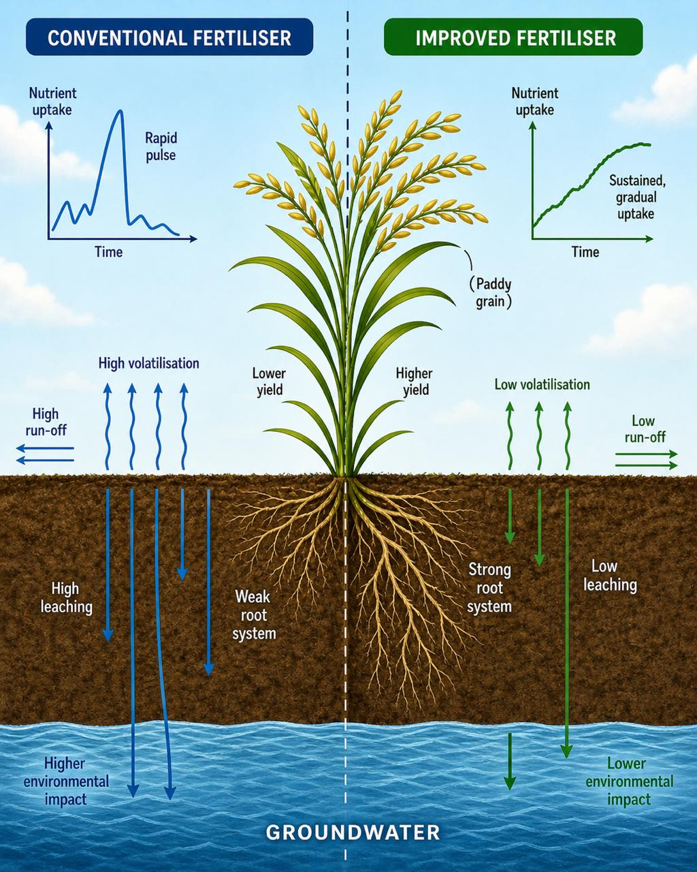
But last year, Wijesinghe was approached by a representative from Plantchem, an agribusiness subsidiary of DIMO, a machinery company. He brought a new type of fertiliser — limus-treated urea. Limus, the representative explained, ensures that the nitrogen stays near the plant’s roots for longer. It prevents nitrogen’s release into the atmosphere as harmful gas for up to three weeks. This helps the plant get consistent nourishment, and minimises nutrient wastage.
Limus is the brand name for a treated urea developed by BASF, a German chemical giant. It’s one of many “improved” fertilisers, and more effective than the conventional or “straight” fertilisers that farmers like Wijesinghe had been using.
The officer suggested that Wijesinghe trial the new fertiliser on just one of his five acres of paddy, and judge the results for himself. Potentially risking a fifth of the income that would sustain his family for the next six months, Wijesinghe agreed to give this new fertiliser a chance.
“When we look at the newspapers, or when watching the TV, we come across different ways of improving our yields through new products and technologies, so it’s always on a farmer’s mind,” reflects Wijesinghe.
Wijesinghe’s gamble paid off. He would’ve normally used 150kg of urea an acre for the season, but he only had to use 55kg of the limus-treated one. Along with over a 50% reduction of fertiliser used per acre, he also saved on time and labour costs.
And most importantly, there was a clear difference in the plant growth.
“Earlier, when I applied fertiliser thrice, the plant growth was like a wave. It was a strong green colour as I first applied urea, and then it would fade a bit. When I reapply it, it becomes green again, and so on. The limus-treated urea doesn’t affect the plant like that. There’s a consistent green colour in the field throughout the season, and it doesn’t fade away.”
There were other differences between the two plots. In the one acre where limus-treated urea was applied, plants were healthier and more resistant to pests and diseases. They also had more stalks, and each stalk contained about 270 grains — nearly 60% more than in the straight fertiliser plots.
At the end of the season, Wijesinghe harvested nearly ten more bundles of rice from this acre than the others. Even at a minimum rate of 110 rupees per kg, this amounts to a good 64,000 rupees in additional income per acre for the season.
An opportunity to “improve”?
The limus-treated urea that Wijesinghe uses is part of a bigger shift in Sri Lanka’s fertiliser sector — from straight fertilisers to improved varieties.
Straight fertilisers that farmers like Wijesinghe have been using since the Green Revolution of the 1960s contain only one nutrient in a granule. They aren’t very effective as they release most of their nutrients right after application. These then get wasted away by escaping into the atmosphere as a gas, dissolving into groundwater, or washing away from the soil surface due to rain or irrigation.
Although 64% of the urea imported to Sri Lanka between 2015 and 2017 was used for paddy cultivation, only about a third of that was actually absorbed by wetland paddy.
About 60-70% of straight fertiliser is wasted in tropical, wet countries, says S. P. Nissanka, the general secretary of the Sri Lanka Institute of Agriculture. These nutrient losses are especially severe in paddy, a crop subject to heavy rainfall and farmer mismanagement, leading to many environmental and health issues.
Recognising these limitations in straight fertiliser, globally, researchers and agribusinesses have moved on to producing more advanced fertilisers. They may contain multiple nutrients within one granule — compound fertilisers — or a single nutrient designed to release nutrients more slowly over time —- slow or controlled-release fertilisers.