
China’s public security ministry said Sri Lanka’s police used intelligence they shared to bust Chinese scamming rings. The Examiner hasn’t been able to get confirmation from the police yet.
Since the beginning of the year, over 850 foreigners have been arrested across eight districts. According to the police, most are from India, followed by China, Vietnam, and Cambodia.
Chinese-run scam operations in Sri Lanka are not new. As far back as 2012, the police arrested at least 13 Chinese scam lords.
Arrest numbers over the past two years suggest that scammer activity has been rising. Police arrests nearly doubled since 2024. “Since the beginning of this year, some individuals involved in telecom fraud and related illicit activities have moved from other countries to Sri Lanka in an attempt to rebuild their criminal networks,” the Chinese government said in April.
In a report on global scam centres, the UNODC, the UN’s crime agency, noted that Sri Lanka shows signs of becoming a base for scammers.
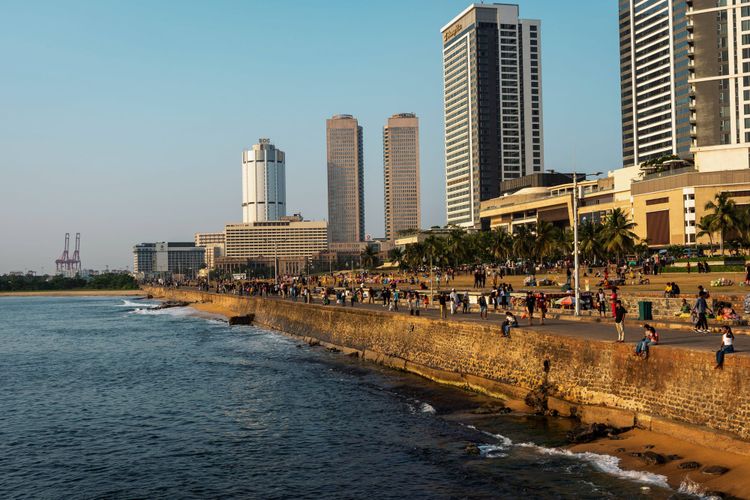
Real estate agents also confirm that they have been receiving more suspicious queries from Chinese nationals in the last year and a half. The Examiner spoke to three real estate agents who all said that central Colombo is the most popular. The agents confirmed that there are entire buildings in Colombo that have been rented to Chinese nationals, with one floor operating as a canteen, another as accommodation, and a third for operations.
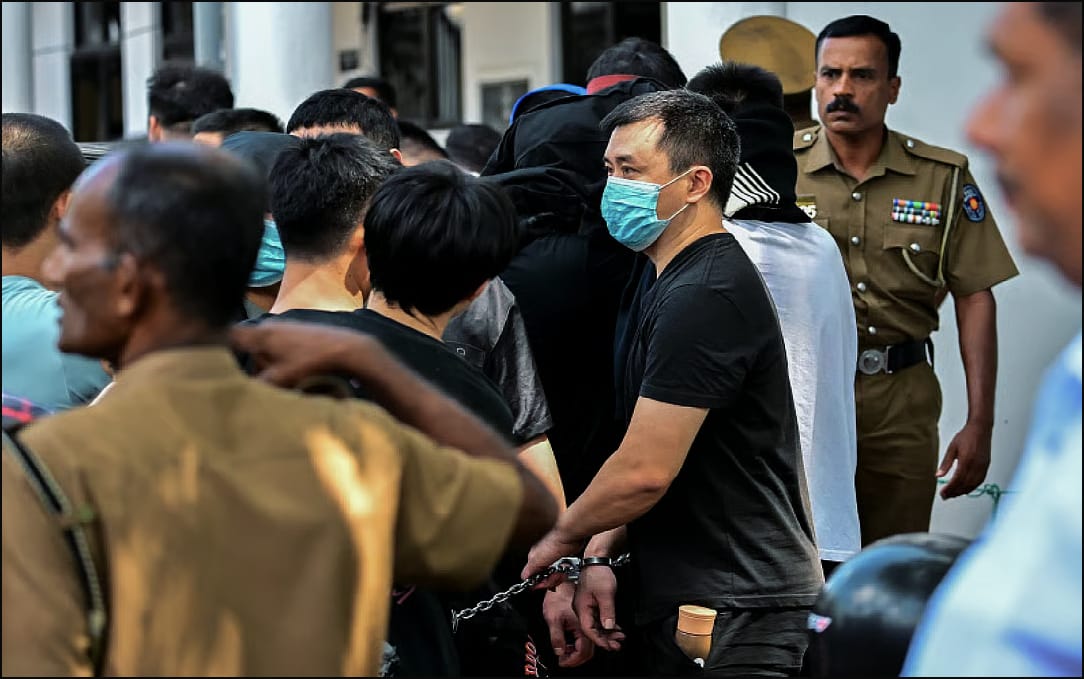

Over 200 foreigners connected to the scam operations have been arrested outside Colombo in May. Photo: Ishara Kodikara/ AFP
The renters, groups of foreign men, are often looking for multi-bedroom apartments. Claiming to work for IT or BPO companies, typically at least one person will have a valid business visa.
These groups pay upfront, often offering double the market rate. “They showed up with cash to pay for the full year, six million rupees,” said one agent. “The owner wanted it to be deposited, so they had to spend a few hours taking turns going to the bank and depositing 200,000 rupees each time.”
Operational trends
Real estate agents are noticing shifts in recent months. Previously, demand for suspicious rentals was limited largely to Colombo. But this year, an agent confirmed that requests for spaces outside Colombo are increasing. Over 200 foreigners connected to the scam operations have been arrested outside Colombo in May.
The agent was also asked to find a warehouse this year, and separately, a space to house a hundred people. His experience could suggest that the scale of operations is growing. Recently, Customs officials seized 383 mobile phones, 101 tablets, and a GPS tracker on suspicion of their being used for scams.
The large number of Indians arrested also suggests that Indians may be a major target. “You get Indians when you want to scam Indians,” explained a representative from the Global Anti-Scam Organisation. “We’ve seen cases where the whole company is Indian, but the boss is Chinese.”
There is also likely local support. Local companies appear to be arranging extended business visas through sponsorship. A real estate agent said their visas say they are attached to local BPO companies.
At least one real estate agent exclusively caters for this market, as some landlords are now adopting a “no Chinese” policy. The Global Anti-Scam Organisation representative also confirmed that while they were unaware of the situation in Sri Lanka, in all other countries, scammers paid “protection money” to local authorities.
The cyber scam industry is a multi-billion dollar business, operating primarily in Myanmar, Cambodia, Thailand, Vietnam, and the Philippines. In particularly unstable countries like Myanmar and Cambodia, scammers build fortress-like compounds to house thousands of workers.