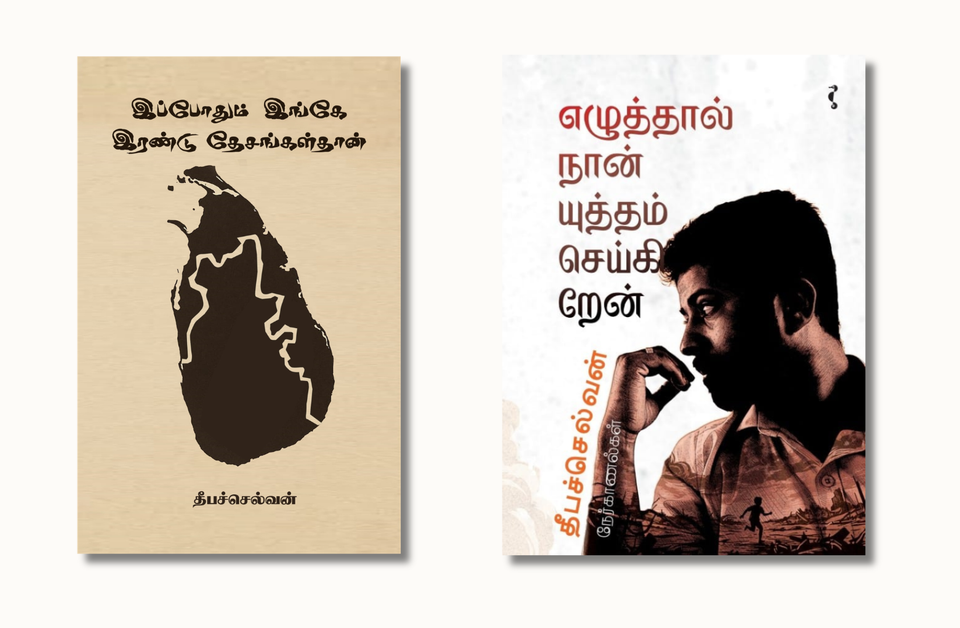
Customs continues to detain two sets of books by author Theepachelvan Piratheepan, on the defence ministry’s advice. The detained books are a collection of essays and interviews on the war, and Theepachelvan’s personal life. The culture ministry intervened to get two other sets — the novels — released. Although the Arts Council says they only made recommendations to release two of the books, an external review report the council called for contains observations on all four.
Customs officers seized the books on March 18th, suspecting they could threaten national security. Seevali Arukgoda, Director General of Customs, said the suspicion arose from one book’s cover, which depicted a map of Tamil Eelam separated from the rest of Sri Lanka, and “limited inspection of the contents”.
“Our officers are not experts in making decisions to this effect,” said Arukgoda. He explained their process: if they suspect a security threat, the defense ministry clears the books’ release, but if they suspect religious incitement the culture ministry provides clearance.
Suspecting a risk to national security, Customs sought the defence ministry’s advice. Based on a complaint from Theepachelvan, the culture ministry also asked for copies.
“Without their input we could have made a decision. But we went one step ahead,” said Arukgoda, adding that Sunil Senevi, the culture minister, had requested that the books be referred to his ministry too.
The defense ministry recommended that Customs detain all four books while the culture ministry recommended the release of the two novels. Customs then went back to the defence ministry, seeking a “no objection” for the release of these novels, which they promptly received.
Customs said the seizure was in conformity with the Customs Ordinance which reads “any newspaper, pamphlet, leaflet, book, or picture containing matter calculated to lead to acts punishable under section 120 of the Penal Code” can be detained by officers. Section 120 deals with “disaffection” against the government.
The defense ministry did not respond to questions on how it decided the books incited “disaffection” or were a threat to national security.
The two books that were released were not first editions, had already been distributed in Sri Lanka, and are available at Tamil bookshops.
Customs criticised
The seizure was condemned by civil liberties activists, who say it violates freedom of expression.
Typically it is the Attorney General’s department, not the defense ministry, which advises the government on legal questions. In this case, Customs needs to know whether the books contain “matter calculated to lead to acts punishable under section 120 of the Penal Code”.
“Why should we consult the AG’s department?” Arukgoda asked, when The Examiner inquired whether the Customs department had reached out to the attorney general. He held that defense ministry observations are sufficient, adding that this has been the practice for as long as he can remember.
Gehan Gunatilleke, a legal scholar, said that Sri Lanka has many archaic laws because “colonialists thought the natives are so hotheaded they would fight over anything that is deemed offensive”. This historical context birthed public order laws against causing offense, like in the Penal Code and the antiquities law, with very broad provisions.
Another lawyer, who previously represented authors imprisoned for their writings, said that the courts will need to interpret section 120 to avoid further arbitrariness.
Mystery Arts Council reviewers
Opposition to the books’ detention grew louder when Customs released a statement, suggesting that the defence ministry, Arts Council, and the state literary panel recommended that two books remain in detention.