The Examiner has more opinions than it has staff. We maintain unanimity in our facts, not the inferences we draw from them. This examination is no exception.
“They lived without being second to any nation in the world,” is our tenth grade history textbook’s description of ancient Sri Lanka. From cover to cover the textbook praises our “Intelligent kings,” “efficient rulers”, and “great civilisation.”
But real history isn’t so grand nor so clear-cut. Teaching it as such is a choice — a conscious, political one. When examining the history textbooks, it’s clear that the syllabus has chosen heritage over history, and Sinhala Buddhist heritage over all others.
Nation-building through history
The textbooks repeatedly call the island’s earliest inhabitants “Sri Lankans.” But ‘Sri Lankan’ did not exist as a category in ancient society.
Modern identities are unquestioningly projected onto ancient peoples. Until the 19th century, people did not conceive of themselves as belonging to one unit — the country. They barely considered themselves as belonging to large groups like ethnicity. Rather, people lived in small kingdoms and identified themselves by family groupings, region, occupation, or caste.
The textbooks do speak of small family groupings led by parumakas, chief-type figures, developing into cities run by kings. But the constant references to “Sri Lankan” and “the country” subtly instills the idea that an islandwide identity also permeated ancient society, and that the modern national identity is its natural continuation.
The national identity tilt is unsurprising. Afterall, one of eight “national goals” for education as per the official teacher’s guide is “nation-building and the establishment of a Sri Lankan identity.”
Shamara Wettimuny, a historian, says post-war, there were incremental improvements in the history syllabus. But for her it’s not enough.
“The pedagogical instinct is to instill patriotism,” she said. “Ultimately the mindset hasn’t changed.”
Re-writing an idyllic past
The textbooks cover a wide variety of sources, including literature, archaeological ruins, and inscriptions. The tenth grade book does not shy away from the limitations inherent in excavating history from archaeology.
“It is difficult to come to a definite conclusion on the size of the ancient settlements,” reads one section. “But, according to the evidence found in the archaeological research carried out so far, a small-scale village was normally not more than 0.15 hectares.”
But the care afforded to nitty-gritty archaeological details are not afforded to their broader framing. In the mission of painting a glorious and idyllic past, the textbooks mislead.
“There was mutual support and harmony in the village. There was no working for wages those days,” reads the eleventh grade textbook.
While ancient society was far less commodified than today’s one, wages did exist. Malani Chandrika, a history lecturer writing on women’s employment in ancient Sri Lanka, lists the many ways in which they were paid, from gold to land.
In the eleventh grade textbook’s colonialism section, the “emergence of a landless social group” is listed among the devastations of foreign rule. Colonialism stripped many people of their lands, turning them into plantations for colonial profit.
But landless groups existed in medieval kingdoms too, so deprived primarily because of their caste. Slavery and caste, some of the less rosy features of ancient society, are given little more than a cursory mention.
The textbooks are not solely to blame for such rose-tinted lenses. Much of what we know about ancient history is limited to the realm of religion and royalty. Not that of ordinary people, and certainly not that of the most downtrodden. In part, this is because royalty’s triumphs and monks’ virtues were more likely to be recorded — in inscriptions and literature. Their ruins too, made of stone, were more likely to survive than those of mud huts.
Excluding minorities
Another strategy deployed in the nation-building project is omission. By leaving things out, the textbooks offer a simplistic, cohesive past that never quite was.
The complexity of ancient Lanka and the diversity of its peoples are pushed to the margins. In the process, the books inconspicuously decide who does — and who does not — count among our ancestors.
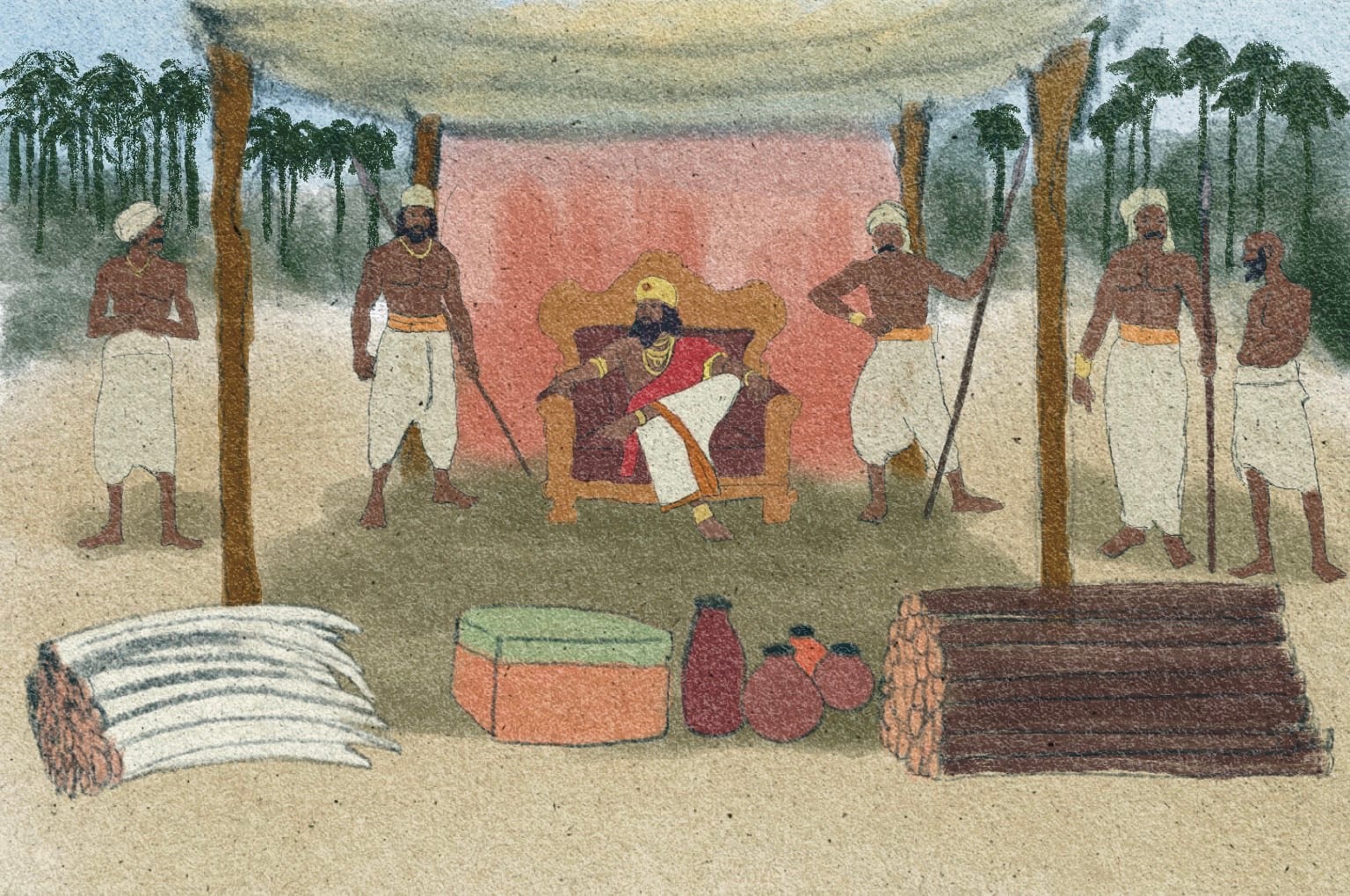
Kandarodai in Jaffna, Anuradhapura, and Tissamaharama are the first three urbanisations on the island. But Kandarodai was dropped from the textbook.
The textbooks place Buddhism as the island’s first organised religion, saying Hinduism, Islam, and Christianity “spread within society in later times.” This isn’t true.
Several religions existed prior to Buddhism’s arrival in Sri Lanka, including Shaivism and older traditions of Hinduism. Inaccurately and unnecessarily naming Buddhism as the first continuously practiced religion fuels the fire of the odious ‘who came first’ battle.
In the last decade the syllabus has improved. Prior to revisions in 2015, textbooks incorrectly portrayed Tamil entry to the island as that of invaders. Now the textbooks explicitly talk about Tamil traders inhabiting the island for over a thousand years. The 2007 textbooks built a framing that was centred on conflict between ‘legitimate’ Sinhala kings and Tamil ‘invaders’. The current textbooks don’t refer to Tamils at all when discussing South Indian invasions.