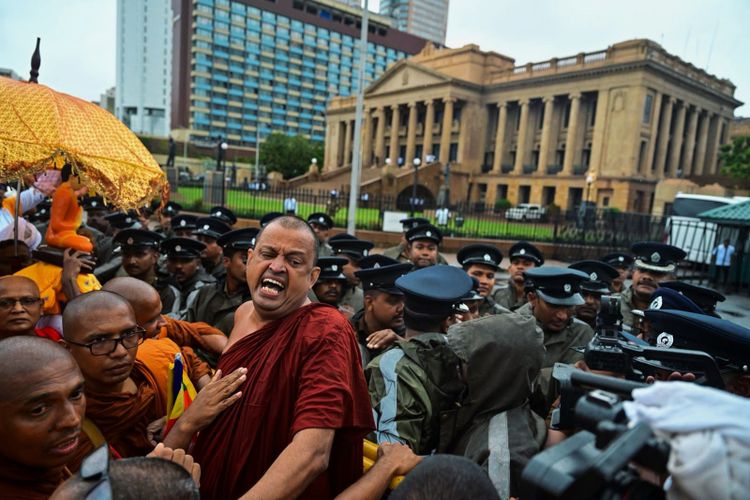
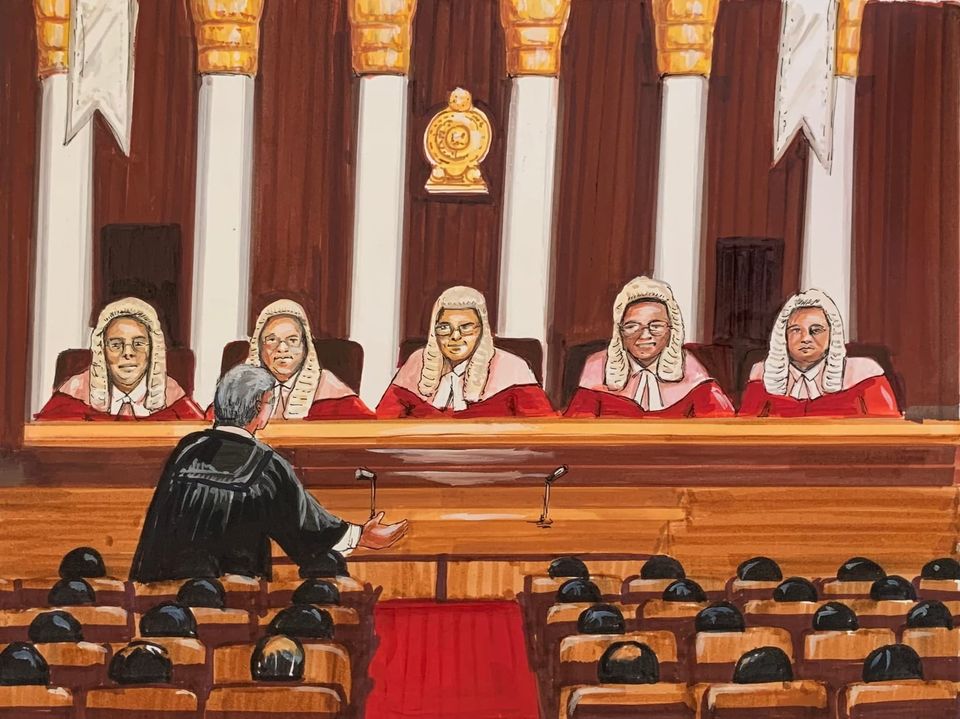
When the Supreme Court started considering the 22nd amendment’s constitutionality on Tuesday, court room 502 was packed to the brim. The government’s widely-criticised amendment drew lawyers, journalists, and independent observers in numbers. The sittings, heard by a five-member bench with Chief Justice Preethi Padman Surasena at the head, moved to the more spacious Ceremonial Hall.
At 11am, they began hearing the 67 petitions. M.A. Sumanthiran led the charge appearing for the Bar Association — the government’s main adversary in the matter.
Even though not all constitutional amendments require a referendum, Sumanthiran’s opening argument was that this amendment does. He referred to the Supreme Court’s 2022 determination that judicial independence was part of the people’s sovereignty — thus this amendment's successful passage would require a referendum.
People’s sovereignty
Viraj Dayaratne, appearing for the attorney-general on Wednesday, didn’t contest this point. He told the court the government would accept a referendum if the bill genuinely affected judicial independence.
Thus on Tuesday much time was spent on what was ultimately an uncontested point. With Dayaratne’s acquiescence on Wednesday, the main point of contention thus became whether the amendment affects judicial independence, or not.
Limits of tenure
On Tuesday, Sumanthiran submitted that certainty of tenure — the certainty that a judge’s tenure on the bench wouldn’t ever change — was essential for judicial independence. It eliminated the possibility that judges could be induced by attempts to lengthen their terms. He told the court that the current amendment, by changing the term of currently sitting judges, as opposed to future judges, constituted interference in judicial independence.
Sumanthiran drew parallels to another great exercise of the people’s sovereignty — the election of the president. If an amendment changes the president’s term of office it would require a referendum, he said. The same logic should apply to judges' terms.
He buttressed his argument with Supreme Court precedents, including the time when Vijitha Herath, a current cabinet minister, introduced a private member’s bill to abolish the executive presidency when he was in opposition.
Sumanthiran also reminded the court that perceptions of judicial independence would be affected, and that that was extremely important. This argument served him well in the past, when he successfully defended the Constitutional Council’s decision to reject a controversial judge’s nomination to the Supreme Court in 2024.
Judges’ terms
Ali Sabry, appearing for G.L. Peiris, drew the court’s attention to the 22nd amendment potentially reducing judges' retirement ages. If the amendment passes, chief justices will retire either at 67, or when they complete six years in office, “whichever occurs earlier”. A chief justice appointed at 57 years would now have to retire at 63, whereas without the amendment they would continue till 65.
He also reminded the court of its reasoning in the celebrated Bracegirdle case. The Governor of Ceylon had attempted to deport a British planter-turned-trade unionist. But the Supreme Court had ruled against deportation, demonstrating, according to Sabry, that the judiciary had exercised its independence even at a time when sovereignty was vested in the Crown rather than in the people. The principle of judicial independence is older than the principle of sovereignty being vested in the people.
History demonstrates that the judiciary has a duty to protect its independence even against the executive, he said.
The executive’s trap
Sabry also warned judges that the amendment could be a “trap” set by the executive. He referred to Mohan Pieris’ appointment as chief justice, after Shirani Bandaranayake’s wrongful impeachment. Questions arose as to whether the judiciary remained independent after his appointment.
“This is bait. Do not take the bait,” he exhorted the court.
Usurping the president
Geoffrey Alagaratnam argued that the 22nd amendment usurps the powers vested in the president and constitutional council. They have sole responsibility for judges’ appointments.
When they appointed the current Supreme Court judges, they did so assuming their tenure would end at 65. If this amendment were to pass, Parliament would be effectively giving these judges a fresh appointment, usurping the powers vested in the president and constitutional council, he argued.
Spirit of “special majority”
Jayampathy Wickramaratne’s argument appealed as much to constitutional convention as the letter of the law.
He argued the two-thirds majority required for a constitutional amendment isn’t limited to a numerical majority. Instead, a “special majority” envisages a broader consensus among different political parties in Parliament, reflecting cross-party support for a fundamental constitutional change.