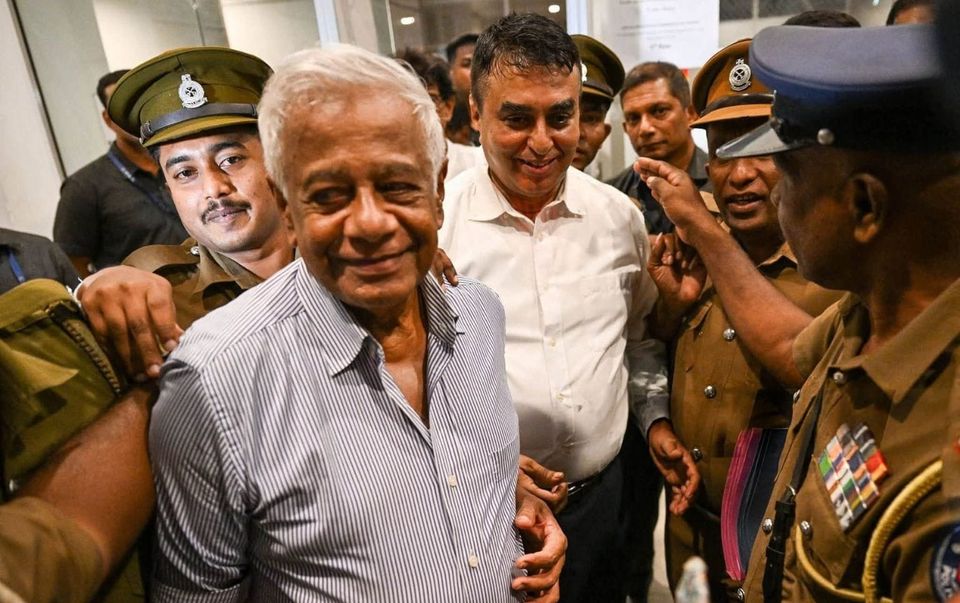
For the first time in history, the courts sentenced a former Inspector General of Police, IGP, and an ex-defence ministry secretary to death.
In a closely-watched trial, two of the three judges hearing the case found Pujith Jayasundara, who was IGP when the Easter bombings took place, guilty of murder. They held that his failure to act on intelligence amounted to murder. Hemasiri Fernando, who was the defence ministry secretary at the time, was similarly found guilty.
Their lawyers plan to appeal the verdict.
A sin of omission
Priyantha Liyanage and Thilakarathna Bandara, the two judges in the majority, held that the prosecution proved beyond reasonable doubt that Jayasundara and Fernando received intelligence about the attacks but failed to take necessary measures within their authority to prevent them. They held that this amounts to murder under the fourth limb of section 294:
“If the person committing the act knows that it is so imminently dangerous that it must in all probability cause death, or such bodily injury as is likely to cause death, and commits such act without any excuse for incurring the risk of causing death or such injury as aforesaid.”
Nilantha Jayawardena, the then State Intelligence Service chief, gave information to Jayasundara that suicide bomb attacks were planned for Easter Sunday. Despite knowing that attacks were to be carried out, Jayasundara failed to take necessary steps to prevent them, the judges noted.
“Through this conduct, he acted in a manner that facilitated the commission of these crimes,” said Liyanage, reading out the judgement.
During the proceedings, Jayasundara admitted that he received information on eight occasions from April 8th 2019, over a month before the bombings. But he claimed that this information wasn’t “confirmed” intelligence. As such, he couldn’t take action to the extent expected of him.
Jayawardena, the former intelligence chief and a key witness in the trial, conceded that his information “required further confirmation”.
But the intelligence given on the eve of April 20th, less than 24 hours before the attack, was different, ruled the judges. Jayawardena gave information to the former IGP on how eight suicide bomb attacks were planned for the next day. Liyanage observed that this had a “continuous connection” with information on April 16th that the same group rehearsed by detonating a motorbike in Kattankudy. Thus, the information can be accepted as confirmed intelligence.
Liyanage went on to explain how Jayasundara didn’t perform his duty. He observed the police had an advanced communication system which gave Jayasundara the ability to immediately inform all police stations of the planned attacks.
“He could have obtained the assistance of the police Special Task Force under his command and taken measures to prevent the attack. He also had the ability to deploy the armed police forces under his authority for this process.”