This political column continues the island’s long tradition of insider political journalism, from the 19th century Ceylon Examiner to today’s Sunday Times Political Column, and, of course, the inimitable Suranimala. We’re still crafting the genre’s 21st century incarnation, so please send us feedback on what works, and what doesn’t.
Nearly two years after its electoral breakthrough, the government is discovering that winning elections is one thing, governing is another.
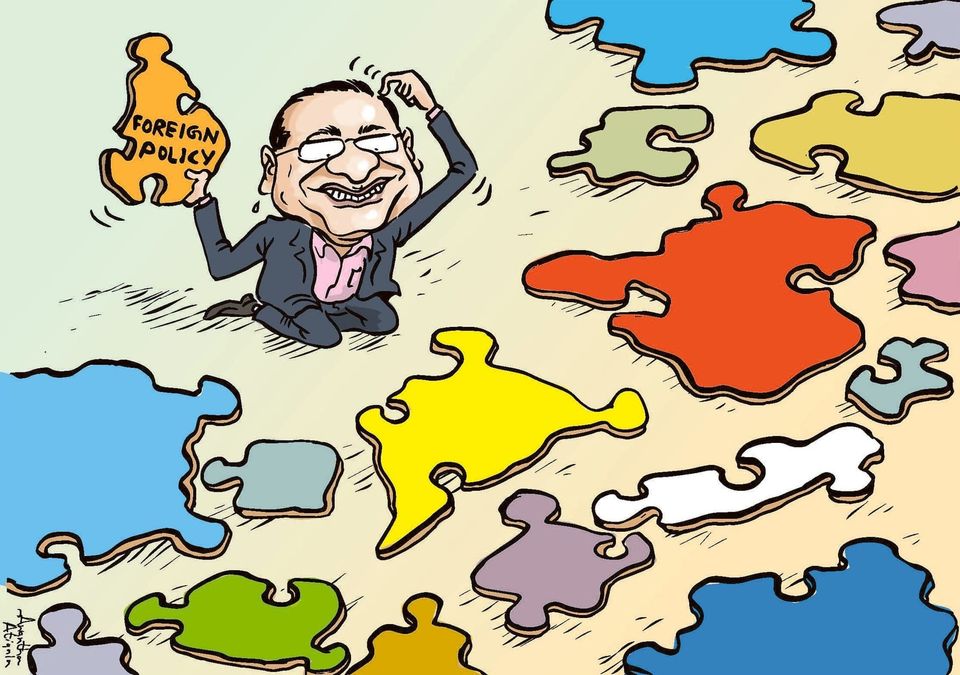
Foreign affairs is one domain where the strain is clear. The government’s trying to sustain Sri Lanka’s long-standing policy of attempting to befriend everyone, but in an increasingly polarised world that’s becoming harder. Translating talk into action also remains a challenge — at home and abroad.
“Friendship with all” in Trump’s world
Diplomats in Colombo have been quietly asking whether Sri Lanka’s foreign-policy machinery can keep pace with an increasingly complex world stage.
During a recent visit by India’s defence minister, Rajnath Singh, a scheduled meeting with Sampath Thuyacontha, the defence ministry secretary, didn’t happen. A deputy minister told Unredacted that Thuyacontha was double-booked, overseas on an official engagement.
More substantially, at the BRICS summit held earlier this month in India, Sri Lanka wasn’t there. It didn’t get an invitation. BRICS, an inter-governmental organisation, has emerged as a developing country alternative to rich-country discussion forums like the G7. Sri Lanka last made an appearance in 2024 when Aruni Wijewardane, then foreign ministry secretary, attended the summit in Kazan, Russia.
Not having a seat at the table could well be Sri Lanka’s own fault. After applying for membership there was almost no follow-up from the Foreign Ministry, so it's no surprise Sri Lanka remains on the sidelines. Meanwhile, neighbouring countries like Thailand, Malaysia, and Vietnam are on their way to joining the club, having become BRICS Partner Countries.
Sri Lanka also wasn’t at the latest Shanghai Cooperation Organisation, SCO, summit in Kyrgyzstan, despite being one of its first dialogue partners. Sri Lanka skipped last year’s summit too. A more security oriented forum than BRICS, the SCO’s members are developing Asian countries.
However, unlike with BRICS, Unredacted learns that Sri Lanka’s absence at the SCO summit wasn’t a simple mistake, but rather a conscious — if blunt — move to maintain a trouble-free relationship with the US.
The US is Sri Lanka’s single largest export market and the apparel sector just breathed a sigh of relief with the finalization of lower tariffs for Sri Lanka’s exports. Given America’s might and its president’s mercurial disposition, the government is being extra-cautious.
The government’s cautious approach to diplomacy is evident in other foreign policy domains too. Closer to home, the institutionalisation of the Colombo Security Conclave, a gathering of regional national security advisers, remains in limbo. Sri Lanka is yet to sign the conclave’s host country agreement, which will establish its permanent secretariat in Colombo.
President Anura Kumara Dissanayake also won’t be meeting his fellow leaders at this month’s UN General Assembly. He’s sending Vijitha Herath, the foreign minister, instead.
Time to walk the talk
Key foreign partners like India, the US, and China initially gave the government the benefit of the doubt, giving it time to settle in. They now expect delivery to take centre-stage, not merely more talk.
Many foreign diplomats and donors feel that while the government is very cordial at meetings and functions, there is a huge gap when it comes to delivery. This gap even applies to agreements that are done and dusted, with the ink long dry.
Indian officials feel that Sri Lanka has historically been slow to implement bilateral agreements. They say it’s gotten worse now. The Indian government is becoming quite frustrated over continuing delays, including on agreements reached during Indian Prime Minister Narendra Modi’s last visit to Sri Lanka.