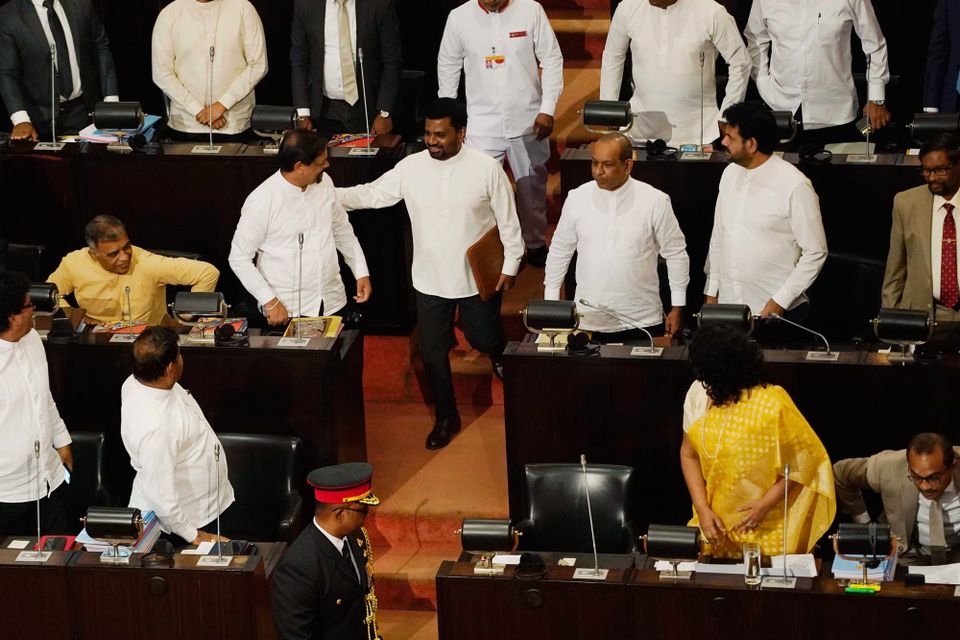
President Anura Kumara Dissanayake, who is also the finance minister, presented a budget that won neither bouquets nor brickbats. “Nothing particularly stupid, nothing particularly great,” was one economist's verdict.
Nearly all the nine economists The Examiner spoke to thought the budget was broadly sensible and signalled continuity. The general view was also that revenue and expenditure estimates were largely realistic. None of their forecasts for next year’s economic growth changed after listening to the budget speech.
The budget’s fine print indicates that the government may be leaning towards another IMF programme, said Umesh Moramuduali, an economist who also used to work at the Treasury. He noticed that the Annual Borrowing Plan in the budget’s technical annexes doesn’t include international sovereign bond issuances for next year.
And without the foreign currency inflows such a bond issuance would provide, the government is likely to face a foreign currency financing gap. The borrowing plan expects $1.44 billion in multilateral financing.
This suggests that the government might already be planning to plug the foreign currency gap with the financing another IMF programme would provide. The current programme expires in March 2027.
“The signal is that they’re considering it very seriously. If we are not issuing [international sovereign] bonds next year, that means the other way for you to raise money is to go for an IMF programme,” Moramudali said.
Dissanayake’s language, at what is probably his most closely-watched speech, also left the IMF door open: “While the programme to stabilise the economy domestically is proceeding successfully, it is difficult to forecast the impacts arising from global and natural disasters at a time when we are preparing for an economic transformation for growth. We believe that our reserves must be further strengthened to successfully face such situations.”
Dissanayake went on to note that the cabinet had appointed a committee to advise on the “suitability of entering into another programme… and on what type of programme it should be.”
This budget contains no fundamental barriers to going for a new programme. It falls within the current programme’s parameters — a condition for receiving its final tranche next yearnext year.
Stabilisation to transformation
The budget speech also signalled a change in the government’s focus. Dissanayake called for a “rapid turn from economic stabilisation towards transformation”, indicating greater focus on economic growth and broader socio-economic development in the coming years. Dissanayake also hopes for 7% growth in the medium-term, an aspiration he first voiced in last year’s budget speech.
None of the eight economists and bankers The Examiner polled expect Sri Lanka’s growth rate to exceed 5% in 2027 — their estimates varied between 3% and 5%. The Finance Ministry’s last published projection, from June this year, also expects a 4.2% growth rate.
Public investment surge
However, there is cautious optimism that higher capital expenditure spending — which includes government spending on roads and classrooms — could provide some growth momentum. “The biggest highlight is the 2 trillion-rupee capex,” said Dimantha Mathew, First Capital’s chief research officer.