The Examiner has more opinions than it has staff. We maintain unanimity in our facts, not the inferences we draw from them. This examination is no exception.
“Teacher loves you” isn’t what students usually hear in stern Sri Lankan classrooms. But Hayeshika Fernando, dressed in a blazer with her hair styled into a ponytail, is no ordinary teacher. She claims to be “Teacher Amma” to the 270,000 students she says have sat in her Zoom classrooms over the years.
These children come to her to get ahead in the grade five scholarship exam — a highly competitive national exam that determines entry to top secondary schools and unlocks bursaries. Her success in helping students crack this often life-changing exam relies on a combination of well-executed teaching and love-bombing.
Through these techniques, she forges an extraordinary student-teacher bond, akin to the relationship fans have to celebrities or the faithful have to saints. When an 11-year-old pupil saw her “Teacher Amma” in person for the first time, she refused to go home until she could touch her hand, her slightly perplexed mother said. But that wasn’t enough.
Wading through a swarm of crying children just like her, she cajoled her father into carrying her close enough to take a picture with Fernando. Finally appeased, with the blurry photo secured, she went back home to Gampola.
Who is “Teacher Amma”?
Sri Lanka’s massive tuition industry, estimated by some to cost parents 200 billion rupees a year, has a codependent, even parasitic, relationship with Sri Lanka’s public education system. Students rely on tuition to compete for opportunities within the free education system. And without tuition income, many school teachers wouldn’t be able to make ends meet.
In 2019, a family spent about 2,400 rupees every month on education — 5.9% of their total spending. When the pandemic closed schools, tuition classes flourished online. Today, a middle-class parent typically spends about 3,000 rupees on tuition a month for a primary student. All of Fernando’s offerings for a grade four or five student costs a parent 5,000 rupees.
In this competitive industry, Fernando, popular both online and offline, has managed to carve out a special place for her class. Children tell their school teachers about her. Parents wish her for Mothers’ Day, as she’s a second mother to their kids.
This feat, achieved through advertising that targets parents, has earned her both admiration and backlash.

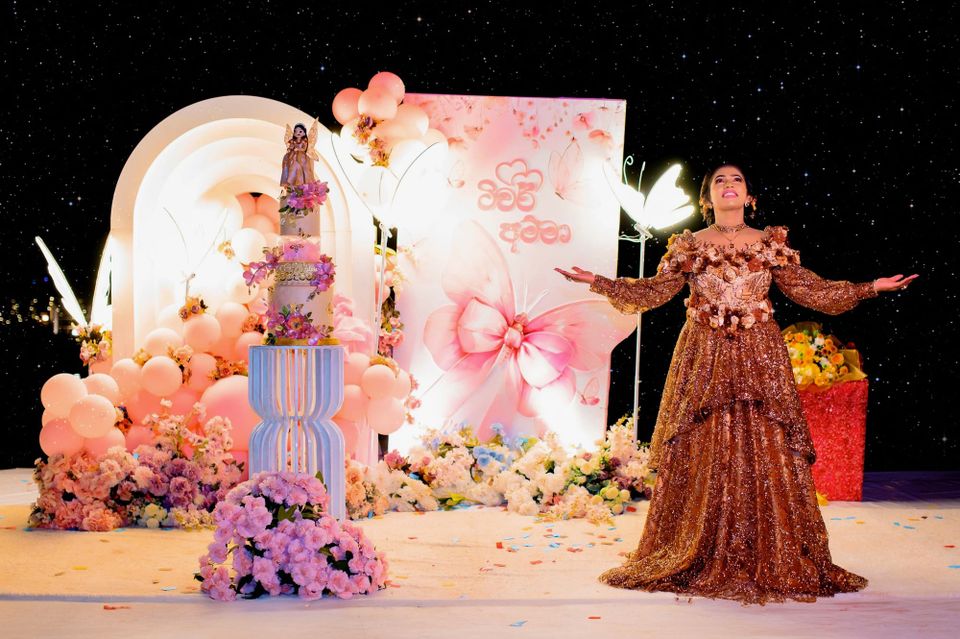
Her social media account offers a steady stream of celebrity-like spectacle. Fernando, clad in a bejewelled saree with a blazer over it and hair adorned with flowers in bride-like fashion, even at times rides helicopters to far-flung parts of the island to hold seminars. She is often seen with her husband and daughter, a large personal staff, and a Range Rover. In class, she speaks to the children in parentese: a sing-song intonation mostly reserved for babies and pets.
Some like this shiny image she projects. But when she makes national headlines, it’s mostly the absurd, or just bad press, depending on one’s inclination. Two years ago, it was for hiring a police escort for her BMICH prize-giving perahera. A few months after that, for being the subject of a police hunt, after having allegedly kicked a man in the nuts.

These aren’t the only controversies surrounding her. She calls herself “Dr. Hayeshika”, claiming to hold two honorary doctorates. One is from a body called the All Ceylon Cultural Social Services Environment Empowerment Organisation, which has no web presence, and, at the very least, doesn’t seem to even claim to be a university. The other is from an institution she doesn’t name.
When netizens debated these credentials, some parents, like Sarah Namanage, thought the backlash was from jealous onlookers.
“Mud slinging has become a hobby in Sri Lanka. There is no way so many children would go to someone without educational qualifications,” says Namanage, whose 13-year-old child attended Fernando’s classes in 2024.
Fernando also claims to hold a Bachelor of Arts from Kelaniya University and a teacher training diploma.
There is one qualification Fernando does not possess — she isn’t a school teacher. Parents generally send their children to teachers who mark the scholarship exam papers. These teachers are government-qualified and attached to a state school.
In a YouTube interview about her life, Fernando says her sister was her first student. She started teaching her when they were both children, growing up in the outskirts of Negombo. Her father was a builder, and Fernando opens up about how his embarrassment at her poor performance motivated to study hard. At a parent-teacher meeting Fernando’s teacher had said: “Upali, though you spend a lot on your daughter she isn’t studying.”
Her first attempt at professional teaching was at a dhamma school. By 2018, she was teaching O level maths to a small group of students. When teaching shifted online during Covid, Fernando found her calling. She went viral through virtual classes. Today, her grade four class alone admits over a thousand students.
Her qualifications may be the subject of controversy, but even school teachers agree that she is talented. Her teaching methods are ordinary — mnemonics, mathematical short-cuts, and animated videos. It’s the relationship she fosters with her students that’s extraordinary.
Even parents can’t fully explain how that relationship develops. Ama de Silva has no explanation for how her children came to be so attached to Fernando. “I cannot fathom how they love her so much.”
Her two girls religiously watch her YouTube videos as they premier. The eldest plays videos on repeat.
Even the younger one, usually reluctant to sit in one place, is entranced by Fernando’s classes. “She does not even let us turn on the TV during that time. We have to be silent.”
They don’t go for any physical classes anymore, all their tutoring is online.
The mother isn’t threatened by her children’s love for Fernando . She feels that her daughters call their teacher “Amma” because they feel that Fernando loves them “endlessly”. De Silva is happy; she credits her children’s love of learning to their relationship with Fernando.
She quoted her eldest daughter: “Though she’s not near me like you [mother] are, I feel her and I love her too.”
Crying children
Fernando runs 11 classes a week, for students from grades two to five. For access to a weekly two-hour class, it costs parents between 1,000 to 1,500 rupees per month. This fee also enables access to recordings and repeat classes.
In this large virtual classroom, where not everyone can see each other, Fernando spotlights students who she feels needs attention. Sometimes these interactions go up on her socials. Viral videos show Fernando’s students crying in class as she coddles them.
In one of the videos, a girl in her class hasn’t answered her question paper. “Don’t you love me anymore?” Fernando asks the child. She responds crying, nodding saying that she does love her. Fernando asks the girl to show how much she loves her with her hands as she cries. Then she questions the child about why she’s crying. “Did someone scold you? Did the teacher scold mage putha?” Then she says that she too loves the girl “a lot”.