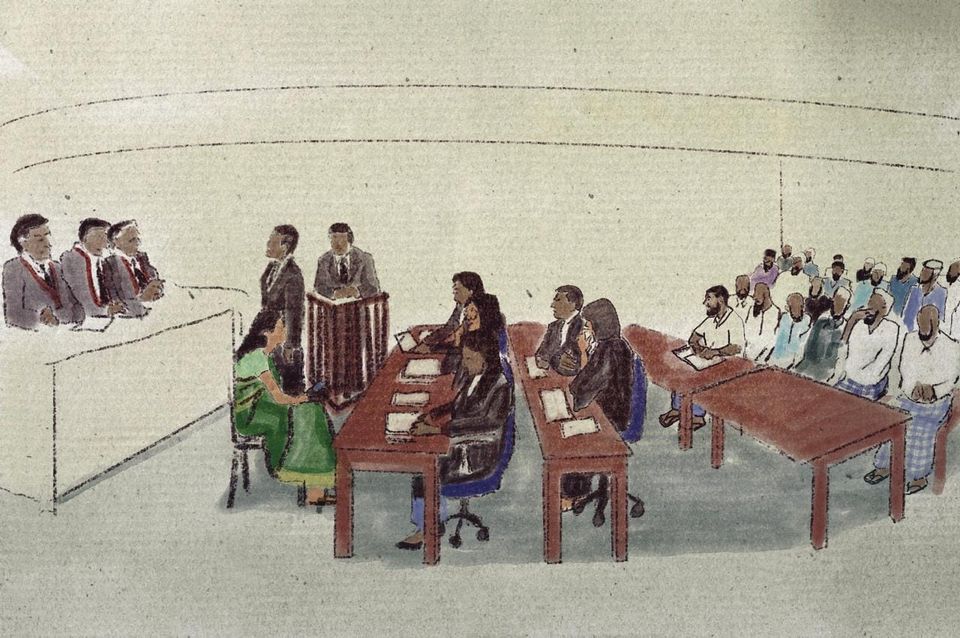
The Easter Sunday trial-at-bar continues to sit daily, even though defence lawyers representing the accused withdrew earlier this week. All but two of the 24 accused are now without legal representation.
They are defending themselves. The courts gave them CR books and pens to take notes, and law textbooks for reference.
Distressed, 22 of the accused asked for defence counsel on Wednesday, and then again yesterday. But Sujeewa Nissanka, a judge, said the court had done all it could.
This included sending a request to the bar association. The appeal reached them mid-January, and they communicated it to their members, the association said. Another lawyer, who the bench had assigned to defend the accused, sat through proceedings on Wednesday. But he withdrew early Thursday morning. His wife’s sudden illness would prevent him from appearing everyday at court, he said.
In January, the court, which convenes at 409 Baudhaloka Mawatha, assigned another lawyer to represent some of the accused. They rejected him as he wasn’t familiar with the PTA, the Prevention of Terrorism Act.
On Thursday, Ibrahim Sadiq Abdullah, one of those on trial, concentrated on taking notes. The witness taking the stand for the day, Kavinda Piyasekera, a policeman, recorded Abdullah’s statement in 2019.
Abdullah started cross-examining Piyasekera in the afternoon, following lunch recess. When Navaratne Marasinghe, the presiding judge, restarted proceedings he said Piyasekara could be cross-examined in Tamil. The court-appointed translator struggled to translate technical terms like the ‘Prevention of Terrorism Act’ from Tamil to Sinhalese, so Marasinghe assisted.
The case started in November 2021. According to the law, trial-at-bars must sit daily. But in practice they do not due to systemic delays like forensics not being submitted to court on time. The charge sheet packs 23,270 charges under the PTA like aiding and abetting terrorism, collecting explosives and weapons, and murder.
Over the next four years, the bench sat thrice a week, in the afternoons. The four-year period saw multiple adjournments; including to allow time for translations of court documents. In that time, one of the accused died.
Then, a few months ago, Padman Surasena, the Chief Justice, decided the trial would be heard daily.
Ghazali Hussain and K.S. Ratnavale, defence lawyers representing eleven of the accused, filed a motion objecting. They said they were unable to defend their clients properly. For instance, their clients’ long incarceration made it “extremely difficult for counsels to have proper consultations and obtain specific instructions” about the trial’s conduct.