The Examiner has more opinions than it has staff. We maintain unanimity in our facts, not the inferences we draw from them. This examination is no exception.
Many moons ago, Thiru Kandiah, an illustrious academic, gave the prize day speech at S. Thomas’ College. He was visiting the island after having spent some years abroad.
“I visited the university and many of the dons were Thomians,” he started. The audience clapped politely. “I visited the law courts, many on the bench were Thomians.” The crowd clapped more enthusiastically. “I visited the banks and the corporate houses, many captains of industry were Thomians.” The audience cheered.
He then said: “I even visited Parliament and many ministers seated on the front bench were Thomians. It was such a delight to see Thomians leading the country in all walks of life.” The clapping was long and the cheering was loud.
Finally, he said: “And then I saw the state of Sri Lanka!” Pindrop silence.
There is no better book to understand this paradox than Richard Simon’s Thomia.
Ceylon’s elite, which consisted substantially of Thomians, was the best prepared in the British Empire for self-rule. But they became the midwives of today’s hopeless Lanka, where almost anyone who can, has left our shores. For this book, ostensibly about S. Thomas’ College, is as much, or perhaps even more, a history of Sri Lanka’s failed promise.
K.M de Silva, the prominent historian, once wrote that almost every feature of modern Sri Lanka can be traced back to the coffee era. S. Thomas’ origins too belong to that time, when the great forces of modernity — the Enlightenment and the Industrial Revolution — arrived on the island via the Colebrooke-Cameron reforms and the coffee plantation.
Simon makes a compelling case that S. Thomas’ was almost as central as coffee to the casting of modern Lanka. In other words, to fully understand S. Thomas’ is almost sufficient to understand today’s Sri Lanka.
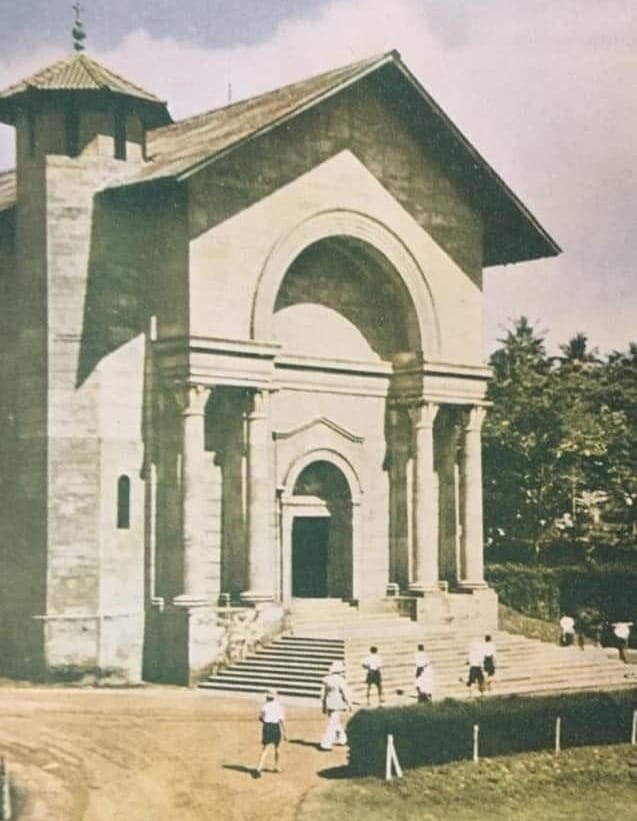
Though Thomia’s substance is academic, its style is journalistic. It embodies the virtues of both approaches but few vices of either. Thus students of Sri Lanka, pressed for time, can take in much of our history canon far more pleasurably by reading Thomia. They can also save themselves hours spent in moulding club bars (or worse refurbished ones) listening to tales of yore, like how the Old Thomian magnate, C.E.A. Dias bought a tea estate just for the pleasure of sacking its English periya dorai.
Yet it is Anandians who will profit the most from Thomia. Ananda College’s alumni haven’t yet covered themselves in quite as many glories as S. Thomas’ men. S. Thomas’ influence — pervasive in all aspects of the island’s life in those crucial decades around independence — has never been surpassed. Many consequential men of that age like D.S. Senanayake, S.W.R.D. Bandaranaike, Dudley Senanayake, S.J.V. Chelvanayagam, D.R. Wijewardene, and N.M. Perera were all sons of S. Thomas’.
Today, there are only two schools in Sri Lanka where one could make a speech similar to Kandiah’s: Royal College and Ananda.
But for Anandians, the case for reading Thomia is even stronger. Royal and S. Thomas’, for all their rivalry, are largely mirrors of each other. Ananda College — with its almost exclusively Sinhalese student body and Buddhist character — represents a distinct, perhaps perpendicular, tradition to S. Thomas’ and Royal. It is also this flavour of Sinhalese Buddhism that has been the island’s guiding spirit since 1956. The sons of both traditions think of themselves as patriots, but their patriotism is of very different varieties.
Ananda, whose school tie can be now found throughout politics, the civil service, the army, and increasingly industry, is in many ways the embryo of contemporary Lanka. It would do well for these leaders to understand and draw from other traditions to refine their own.
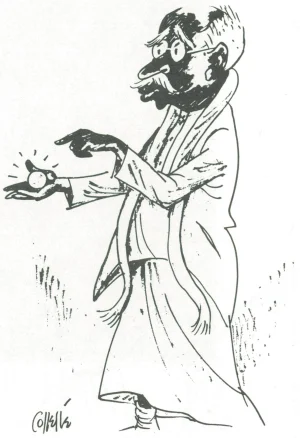
Simon prosecutes Kannangara
And there is no better place to start than with the villain of Simon’s story, whose spirit animates hundreds of the nine hundred pages: C.W.W. Kannangara.
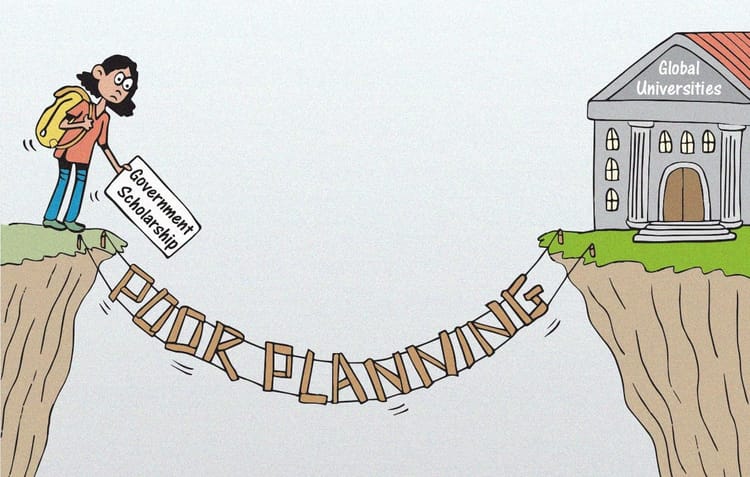
Simon’s polemical and revisionist history argues that Kanangara, popularly revered as the father of free education, didn’t emancipate the Lankan people by giving them the light of education and the learning that allows learning. Instead, he charges that Kannangara’s insistence on vernacular education, to the exclusion of all else, kept the vast majority of the country in ignorance.
Kannangara spearheaded abolishing education in the English medium for all Sinhalese and Tamil students. He also required that English be taught as a language in all schools.
By demoting English from the medium of instruction to the status of compulsory second language, Simon charges Kannangara with the crime of “no upward mobility, no participation in modern society, no choice of occupation, no admission to the great world of affairs and ideas that lay beyond the shores of Lanka” for the vast majority of Sri Lankans. According to him, had English medium education been permitted to flourish, it would have naturally expanded.
For those thus deprived, “their knowledge and abilities would remain strictly provincial, their intellects bounded by ancient structures and superstitions, their worldview a mix of folklore myth and misapprehended, distorted Western ideas.”
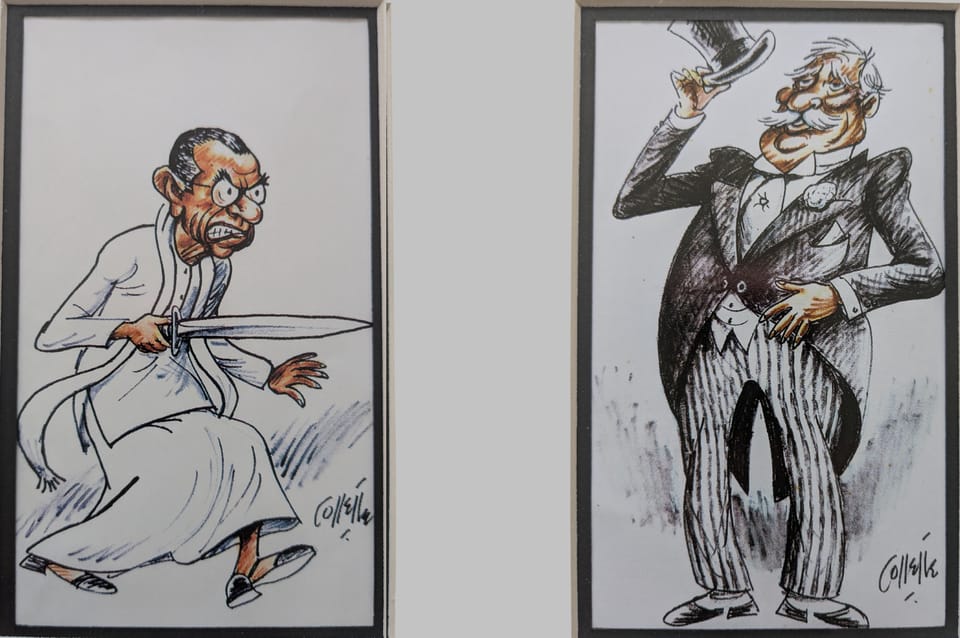
If Bandaranaike was the father of the 1956 Sinhala Only system change, then Kannangara, as presented in Thomia, is its grandfather.
For Kannangara, English was a good thing only for the “nondescript” who laid no claim to a language or race of their own. “But it is not a good thing for those Tamils or Sinhalese or others who have a pride in their race,” he said, as reason for his reform.
Though his Special Committee on Education found that English medium education was the path to affluence and that English-language schools were better schools, it was unable to see any reason for English to be retained as a medium of instruction at any stage of education.
Kannangara was so strong in this belief that he thought it necessary to override a parent’s wishes in determining the language of their children’s education. “Under present conditions we do not think that many parents can be expected to exercise the choice judiciously,” the special committee report remarked.
During his tenure as education minister, overall literacy increased by eleven percentage points. English literacy too jumped, but by much less, 1.8 percentage points.
Those educated in these new schools were often unable to find work fitting their raised expectations. Their animus, Simon argues, was the animating spirit of Sinhala Only.
Simon also trains his guns on the foundation of Kannangara’s wide-acclaim: free education. He states that education, for the vast majority of Ceylonese, was already free of charge. Vernacular schools, whether denominational or state-run, did not charge fees. Nor did any government school, other than Royal College. In short, he says, free education “really amounted to the abolition of the right of schools that taught in English to levy fees”.
However, the leading schools — which offered an education nearly on par with the best in the world — charged high fees, making them inaccessible to all but a small elite, though this was somewhat ameliorated by bursaries and scholarships.
Kannangara argued that any system of public education must be entirely free and under public or state control. His reforms brought schools ever more closely under the state, ultimately leading to the infamous takeover of schools in the 1960s.
Ivor Jennings, of Soulbury Constitution and Peradeniya University fame, who was also a member of the special committee objected to Kannangara. If Kannangara’s reforms could raise the level of all schools to that of the best of them, Jennings said he would have heartily supported them. But he saw the reforms as reducing many of the best schools to the level of the “least good of them”. He dissented from the committee.
R.S. de Saram, S. Thomas’ principal at the time, echoed these concerns when dissenting from the committee too. He added that a more serious danger lay in schools being organised along communal lines.
“It is in the towns that the various elements of the population mix and the process of welding together goes on — which, in the course of time, produces one nation.
In our country districts, communal schools exist. They do so naturally and cause no remark. In the towns, they will have to be enforced; that enforcement will cause remark, and communal consciousness will emerge where it did not exist before. Schools like S.Thomas’ have made a great contribution to the national life just by the fact that boys of all communities have lived and worked and played together with no distinction on groups of race. It will be an inculpable loss if this goes. Whatever happens, at S. Thomas’ it will not go,” said De Saram.
In Thomia, Simon traces how the spirit that animated Kannangara and the reforms he undertook were the handmaidens of what became post-independence Lanka: theocratic rather than secular, majoritarian rather than multicultural, animated by dividing the pie rather than growing it, and insecure and insular rather than open and dynamic. It was no accident that minorities opposed Kannangara’s proposals, and that Kannangara is most revered today by those of a majoritarian bent.
Simon argues that Kannangara’s reforms directly led to the 1956 revolution and the birth of today’s Lanka. This Lanka was built on the following conception of a nation:
“There was one message that all heard in common, regardless of who was speaking and who was listening: Ceylon is rightfully ours: others may have a place here too, but our claim is pre-eminent, because we are more numerous, or better educated, or more civilized, or were here first, or are here in fulfillment of God’s preordained plan — the justification varying from group to group.”
“And so the concept of nationality grew in the minds of the people of Lanka, but not as a common inheritance in which all the peoples of the island, regardless of race, caste, or creed, had an equal share.”
The final word on Kannangara is also best left to Simon himself.
“Sri Lanka progressively lost its regional advantage in educational outcomes as the first products of his system began issuing from Lankan schools in the 1960s and 1970s. It is entirely probable that better results could have been achieved through gradual improvement and development of the existing system, without incurring the social and economic costs — and the national trauma — that arose from Kannangara reforms.”
The Thomian’s Thomian
If Kannangara is the antagonist in Simon’s story, then the Thomian, D.S. Senanayake, is its hero. He is careful not to exculpate Don Stephen, highlighting his evil of disenfranchising upcountry Tamils and his antagonism towards organised labour. He also doesn’t fail to remind us that temperance leader Senanayake’s fortune was partially made in arrack rents, fitting for a family from Botale.
Despite all this, Simon commends Senanayake’s vision of Lanka: multicultural, secular, open to the world, and closely connected to Europe. And this, he thinks, was partly a Thomian legacy.