Although the Malwatta chapter temporarily suspended Pallegama Hemarathana, a top monk accused of child rape, from his duties, it won't decide on expulsion until the court's verdict arrives.
Last month, police arrested Hemarathana, the chief prelate of Anuradhapura’s eight sacred Buddhist sites, on suspicion of raping a minor. He was later granted bail by the Anuradhapura magistrate’s court. The girl, who is now 14, has alleged the monk first raped her about three years ago.
Hemarathana’s high-ranking position in the sangha community drew widespread attention to the grave allegations. The Buddhist institutions he is attached to — the Siam monastic order and its Malwatta chapter — are adopting a ‘wait-and-see’ approach.
Mahawela Rathnapala, a monk and Malwatta’s deputy registrar, told The Examiner that the monastic order won’t be conducting its own internal investigation into Hemarathana.
“Based on the court’s decision, we’ll take a decision. Until the court proceedings are finalised, we have decided to temporarily suspend him from his positions. As the court proceedings are ongoing, we won’t do an investigation,” says Rathnapala.
The vinaya — the Buddha’s code of discipline for monks — marks sexual relations of any nature as one of four principal offences a monk can commit. Committing any one of them results in the person instantly ceasing to be a monk. It also lays out a system of ecclesiastical justice for adjudicating and enforcing monastic discipline.
This 2,500-year old code forms the basis of the current systems used by monastic orders in the Buddhist world, though they vary in their precise organisation and application.
Both chapters of the Siam Order, Malwatta and Asgiriya, appoint a chief monk for each locality, and a monk to take charge of legal matters. If a complaint is made against a monk in their locality, these two conduct an initial inquiry. If it can’t be resolved at the local level, the complaint is taken to the sangha sabha, which then appoints a committee to conduct another investigation, says Rathnapala.
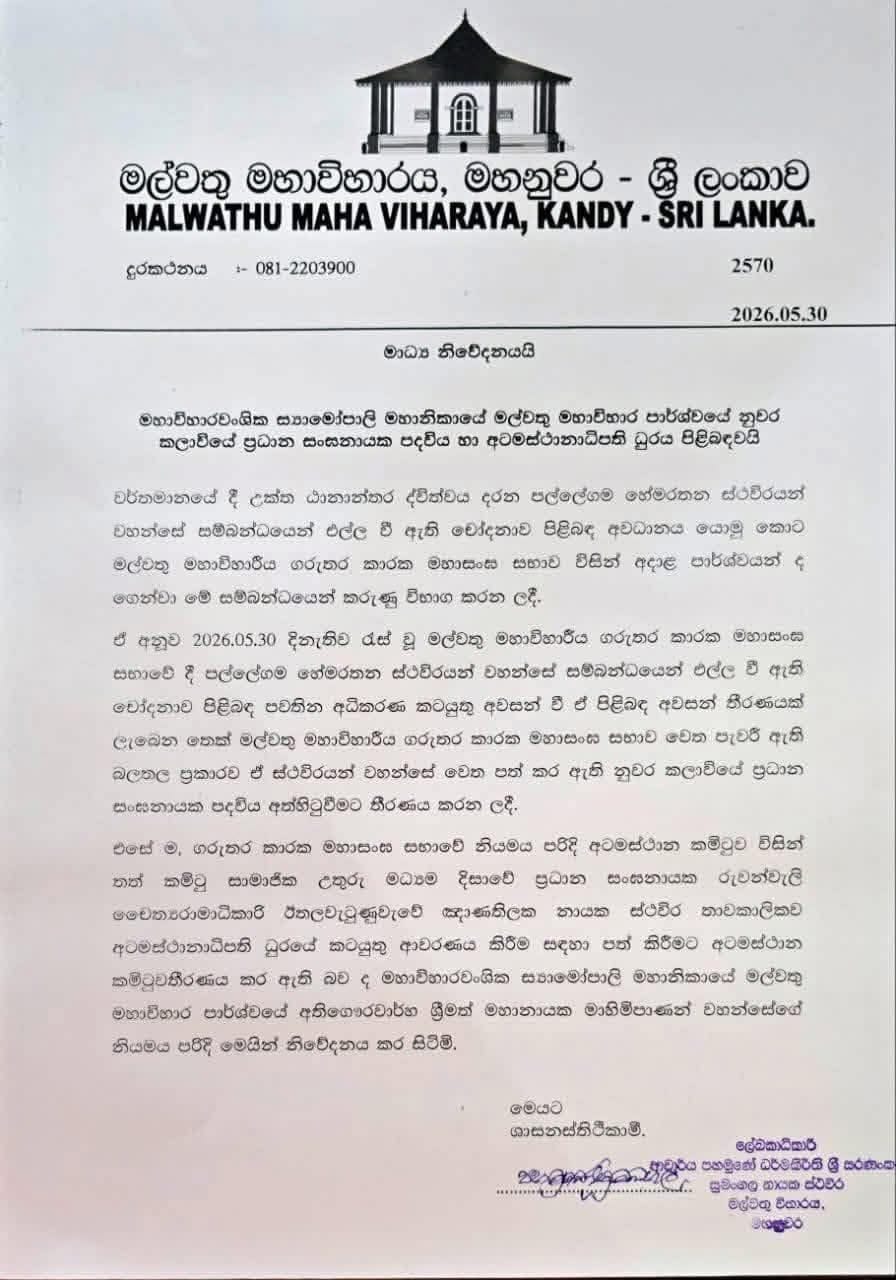
The Malwatta chapter stripped Pallegama Hemarathana of his positions as chief monk for the Anuradhapura region and chief prelate of Anuradhapura’s eight sacred Buddhist sites, pending the court’s verdict. Click for English Translation Photo: Duminda Dissanayake
The chapter hasn’t received any previous complaints against Hemarathana, claims Rathnapala. “We don’t often receive such grave complaints anyway as those complaints usually go to the country’s legal system.”
The National Child Protection Authority recorded 488 complaints of abuse made against Buddhist monks between 2018 and 2022. The authority’s referrals have resulted in charges against 27 accused monks in the past three years.
Expel, not disrobe
Rathnapala says the most serious action the monastic order can take is to expel the offending monk, by taking away their registration documents and informing the Commissioner General of Buddhist Affairs.
Although they can expel a monk, they can’t forcibly disrobe a monk, says Rathnapala. “They must voluntarily do that.”
The vinaya describes disrobing as a voluntary choice made by the monk himself, rather than a formal, centrally-enforced punishment. According to Uduhawara Ananda, a Colombo University Buddhist studies professor, for any of the four serious offences, the sangha courts can investigate and expel a monk. The four ‘defeats’ for a monk are sexual intercourse, theft, murder, and false claims of spirituality. Buddhist nuns have eight serious offences.
If it’s a lesser offence, monks are temporarily rejected from the sangha community and have to undertake a rehabilitation programme, after which they can come back.
Last year, the Malwatta chapter expelled “about four monks” — all of whom were first found guilty in ordinary, civilian courts, says Rathnapala. One of them was found guilty of beating a woman.