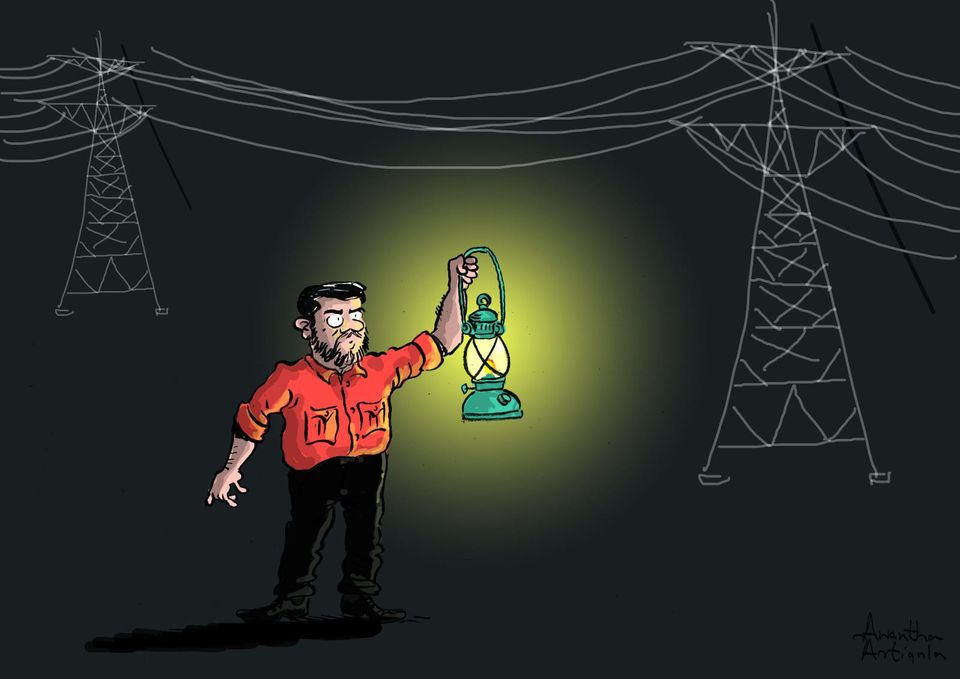
In 2025 a monkey took the blame for plunging the island into darkness. Last Saturday’s blackout, the second under this government, had no such scapegoat. Ministers reached first for the weather, saying lightning had struck the Upper Kotmale hydropower plant.
But from the get-go engineers knew that the trouble started from the Norochcholai coal power plant.
Norochcholai’s Unit 1 had just come out of a two-month long major overhaul. For over a year, it had been producing less power than it should have. Once the unit was up and running again, engineers scheduled some final maintenance at noon last Saturday — a risky time for grid stability as weekend electricity demand is low.
When Unit 1 tripped and stopped feeding the grid with power, the grid’s frequency fell fast. In response rooftop solar inverters, which on that sunny Saturday afternoon accounted for 60% of supply, began switching themselves off, and the grid failed.
“We have already questioned the relevant officials regarding why such risky maintenance was undertaken on a day when system demand was at a minimum, the sun was shining brightly, and large amounts of renewable energy were feeding into the grid,” Anura Karunathilaka, the energy minister, told Parliament on Tuesday.
The moment the power dropped President Anura Kumara Dissanayake called Karunathilaka for details on the outage and asked how long it would take to restore supply. The minister told him that engineers were working hard to get the power back by fixing the circuits at power stations that had tripped.
Once the lights were back on, the president told Karunathilaka to call in the top brass from the energy ministry and the power companies. On Monday afternoon managers from the Norochcholai plant, Electricity Generation Lanka, the National System Operator, the Transmission Network Service Provider, and the National System Control Centre all gathered at the Presidential Secretariat. It turned out to be a momentary reunion for the broken-up CEB.
A committee chaired by Pradeep Perera, the National System Operator’s chairman, was appointed to probe and report on the outage. Their report is expected within a month.
Uncle Sam comes to collect
Sri Lanka’s tariff deal with America — negotiated to minimise the fall-out of Trump’s tariffs — is being put to the test. Two weeks ago, US diplomats in Colombo reminded the government that the deal's terms must be honoured. If not, Sri Lanka could risk the 10% tariff surcharge rising again, they indicated while meeting Wasantha Samarasinghe, the trade minister.
The US is the island’s largest export market, buying nearly a quarter of Sri Lanka’s merchandise exports.
Which is why the government acted decisively when Donald Trump, the US president, slapped a 44% tariff on Sri Lankan goods last year. Mahinda Samarasinghe, then Sri Lanka’s ambassador in Washington, led negotiations to bring it down to 20%, and later to 10%. The quid pro quo was a promise to buy more American goods, with crude oil, LPG, and farm produce all mentioned. America now wants Sri Lanka to deliver on its side of the deal.
During the meeting, the Americans asked the minister to share a concrete list of US goods they would order.
In public the Americans have focused on promoting their agricultural exports. Messaging focussed on how Montana-grown lentils, dry peas, and chickpeas could support Sri Lanka’s food security. A delegation from Montana, including Greg Gianforte, the state’s governor, also visited Sri Lanka earlier this month.
Meanwhile, Sri Lanka hasn’t had an ambassador in Washington since August, and none has been named.
No-confidence motion delayed
The Committee on Parliamentary Business indefinitely postponed debating the no-confidence motion against Jagath Wickramaratne, the speaker.
The government wanted the motion debated and voted on as soon as possible, proposing this week’s Parliament sessions. The opposition argued a single day wasn’t enough as the motion contains around 50 allegations against the speaker.
However, at the committee’s meeting on October 16th, government members flagged technical flaws in the motion, such as the inclusion of an ongoing court case. They said the attorney-general’s legal advice was needed first.